Integrating Custom Operators into a Graph for TensorFlow
The primary difference between TensorFlow and PyTorch scenarios is that the Adapter can automatically generate GE operator prototypes from the TF op_def, eliminating the need for developers to manually write REG_OP. The following figure shows the deliverables. For details about the TensorFlow scenario, see Integrating a Triton Operator into a Graph or triton_add_custom.
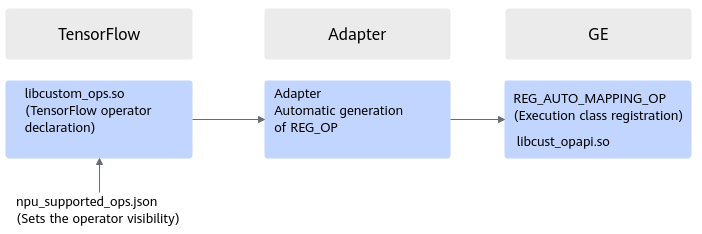
Each phase and its deliverables are described in detail as follows:
- Phase 1: Operator definition
In the operator definition phase, operator metadata, such as the inputs, outputs, and attributes, is declared for use in subsequent phases.
Frontend Framework
Definition Method
Deliverable
Description
TensorFlow
TF op_def
libcustom_ops.so
Operator declaration in TensorFlow. REG_OP is automatically generated by GE.
- Phase 2: Frontend integration
This phase maps frontend operator types to GE operator types and converts attributes.
Frontend Framework
Integration Method
Deliverable Involved
Key Point
TensorFlow
Automatic mapping by the Adapter
npu_supported_ops.json
JSON configuration for operator visibility
The following are required in TensorFlow scenarios:
- Custom operator .so on TensorFlow (to declare operator visibility).
- Deliverable .so on GE (only REG_AUTO_MAPPING_OP is required, and REG_OP is not required).
- npu_supported_ops.json (In TensorFlow scenarios, automatic mapping is performed through the Adapter. This deliverable is a key deliverable.)
Differences from the PyTorch scenario: In TensorFlow scenarios, REG_AUTO_MAPPING_OP can automatically generate GE operator prototypes (including inputs, outputs, and attributes) from TensorFlow operator prototypes, and developers do not need to write REG_OP definitions. This further reduces the overhead for integrating custom operators for TensorFlow.
Example of registering an operator on TensorFlow (using TensorFlow 1.15 as an example):
#include "tensorflow/core/framework/op.h"
#include "tensorflow/core/framework/op_kernel.h"
#include "tensorflow/core/framework/shape_inference.h"
#include "tensorflow/core/framework/common_shape_fns.h"

using namespace tensorflow;

// Register the operator prototype by using the REGISTER_OP API provided by TensorFlow.
// After the registration, the GE Adapter can automatically generate the GE operator prototype from this definition. You do not need to manually write REG_OP.
REGISTER_OP("AddCustom")
    .Input("x: T")
    .Input("y: T")
    .Output("z: T")
    .Attr("T: {float, double, int32}")
    .SetShapeFn(shape_inference::BroadcastBinaryOpShapeFn);

// CPU implementation of the TensorFlow custom operator (CPUs are not supported and only declared.)
// The actual computation is executed on NPUs through the GE graph.
class AddCustomOp : public OpKernel {
public:
    explicit AddCustomOp(OpKernelConstruction* context) : OpKernel(context) {}
    void Compute(OpKernelContext* context) override {
        OP_REQUIRES(context, false, errors::Unimplemented("AddCustomOp is not supported on CPU"));
    }
};

// Register the CPU kernel implementation. (This step is mandatory. Otherwise, TensorFlow cannot load the operator.)
REGISTER_KERNEL_BUILDER(Name("AddCustom").Device(DEVICE_CPU), AddCustomOp);
Example of npu_supported_ops.json:
{
  "custom_ops": [
    {
      "op_name": "AddCustom",
      "op_type": "AddCustom"
    }
  ]
}
Deliverable structure example:
custom_opp/
├── op_graph/
│   └── lib/linux/x86_64/libcust_opapi.so  # GE deliverable (only REG_AUTO_MAPPING_OP is required)
├── framework/
│   └── tensorflow/
│       ├── libcustom_ops.so               # Operator declaration in TensorFlow
│       └── npu_supported_ops.json         # Adapter configuration
- Phase 3: Graph construction and integration
In the graph construction and integration phase, the frontend computational graph is converted into a GE computational graph.
Frontend Framework
Graph Integration Path
Conversion Mechanism
TensorFlow
TensorFlow Graph → GE Graph
Adapter
This phase is automatically completed by the framework, and you do not need to provide any additional deliverables. After the graph integration is complete, the GE graph already contains the custom operator node.
- Phase 4: Graph compilation
The callback APIs for graph compilation are triggered during GE compilation and are used for shape inference, kernel compilation, and serialization. Callback APIs and triggering timing are described in the table below.
Callback API
Triggering Timing
Application Scenario
InferShape
Compile-time shape inference
All scenarios (optional)
InferDataType
Compile-time data type inference
All scenarios (optional)
Compile
Compile-time RTC kernel compilation
Online compilation/Offline OM
Serialize
Writing data to the OM during ATC compilation
Offline OM
For details about the callback API examples, see Callback APIs.
- Phase 5: Graph execution
This phase is the core of custom operator integration. GE calls back the Execute API during execution.
Callback APIs and triggering timing are described in the table below.
Callback API
Triggering Timing
Application Scenario
Execute
Runtime kernel execution
All scenarios (mandatory)
Deserialize
Restoring binary during OM loading
Offline OM
UpdateHostArgs
Updates upon I/O address changes
Static graph offloading
For details about the callback API examples, see Callback APIs.
Mapping between TensorFlow graph integration phases and deliverables
Phase |
Deliverable Involved |
Description |
|---|---|---|
Phase 1: Operator definition |
framework/tensorflow/libcustom_ops.so |
Operator declaration on TensorFlow |
Phase 2: Frontend integration |
framework/tensorflow/npu_supported_ops.json |
Adapter configuration |
Phase 3: Graph construction and integration |
None |
Automatic conversion by Adapter |
Phase 4: Graph compilation |
op_graph/lib/*/*.so |
Callback implementation in GE deliverables |
Phase 5: Graph execution |
op_graph/lib/*/*.so |
Callback implementation in GE deliverables |