aclnnMlaPreprocessV2
Applicable Products
| Applicable Products | Supported |
|---|---|
| × | |
| √ | |
| √ | |
| × | |
| × | |
| × |
Function
Description: In inference scenarios, this API performs Multi-Head Latent Attention preprocessing computation. The main computation process is as follows:
First, RmsNormQuant is applied to the input , then multiplied by for downsampling, and the result is split into path 1 and path 2.
Path 1 undergoes RmsNormQuant, then is multiplied by , and the result is further split into path 3 and path 4.
Path 3 is multiplied by and then outputs .
Path 4 undergoes rotary position encoding and then outputs .
Path 2 is split into Path 5 and Path 6.
Path 5 undergoes RmsNorm and is then passed into a Cache to obtain .
Path 6 undergoes rotary position encoding and is then passed into another Cache to obtain .
Computation Flowchart
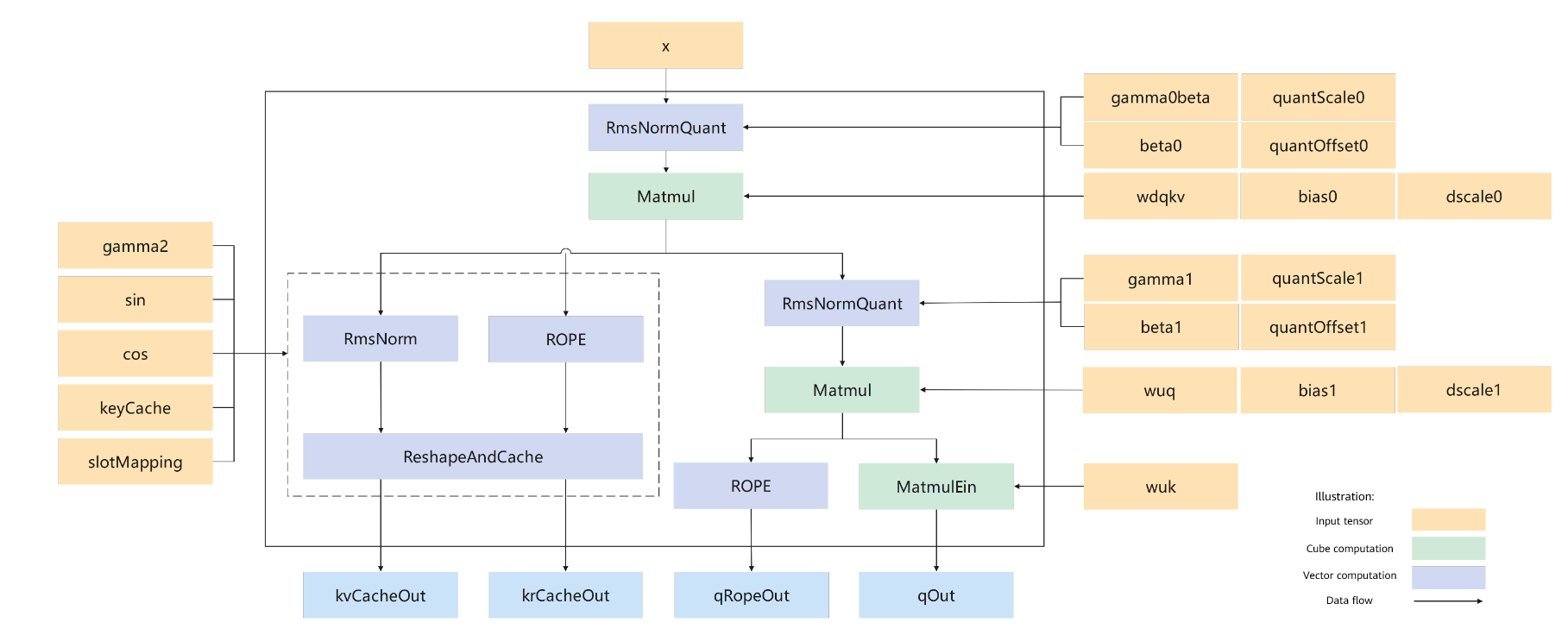
Formula:
RmsNormQuant Formula
Query calculation formula, including W^{DQKV} matrix multiplication, W^{UK} matrix multiplication, RmsNormQuant, and ROPE rotary position encoding processing
Key calculation formula, including RmsNorm and ROPE, and storing the calculation result into the cache
Function Prototype
Each operator is divided into a two-phase API. You must first call the "aclnnMlaPreprocessV2GetWorkspaceSize" API to obtain the input parameters and calculate the required workspace size based on the process, and then call the "aclnnMlaPreprocessV2" API to perform the computation.
aclnnStatus aclnnMlaPreprocessV2GetWorkspaceSize(
  const aclTensor *input,
  const aclTensor *gamma0,
  const aclTensor *beta0,
  const aclTensor *quantScale0,
  const aclTensor *quantOffset0,
  const aclTensor *wdqkv,
  const aclTensor *deScale0,
  const aclTensor *bias0,
  const aclTensor *gamma1,
  const aclTensor *beta1,
  const aclTensor *quantScale1,
  const aclTensor *quantOffset1,
  const aclTensor *wuq,
  const aclTensor *deScale1,
  const aclTensor *bias1,
  const aclTensor *gamma2,
  const aclTensor *cos,
  const aclTensor *sin,
  const aclTensor *wuk,
  const aclTensor *kvCache,
  const aclTensor *kvCacheRope,
  const aclTensor *slotMapping,
  const aclTensor *ctkvScale,
  const aclTensor *qNopeScale,
  int64_t          wdqDim,
  int64_t          qRopeDim,
  int64_t          kRopeDim,
  double           epsilon,
  int64_t          qRotaryCoeff,
  int64_t          kRotaryCoeff,
  bool             transposeWdq,
  bool             transposeWuq,
  bool             transposeWuk,
  int64_t          cacheMode,
  int64_t          quantMode,
  bool             doRmsNorm,
  int64_t          wdkvSplitCount,
  bool             qDownOutFlag,
  const aclTensor *qOut,
  const aclTensor *kvCacheOut,
  const aclTensor *qRopeOut,
  const aclTensor *krCacheOut,
  const aclTensor *qDownOut,
  uint64_t        *workspaceSize,
  aclOpExecutor   **executor)
aclnnStatus aclnnMlaPreprocessV2(
void *workspace,
uint64_t workspaceSize,
aclOpExecutor *executor,
aclrtStream stream)aclnnMlaPreprocessV2GetWorkspaceSize
Parameters
Parameter Input/Output Description Instruction Data Type Data Format Dimension (Shape) Non-contiguous Tensor Input Input x used to compute Query and Key. - FLOAT16, BFLOAT16 ND [tokenNum,hiddenSize] - gamma0 Input The γ parameter in the first RmsNorm computation. The data type must satisfy the data type deduction rules with input (see Deduction Relationship and Constraints). FLOAT16, BFLOAT16 ND [hiddenSize] - beta0 Input The β parameter in the first RmsNorm computation. The data type must satisfy the data type deduction rule with input (see Deduction Relationship and Constraints). FLOAT16, BFLOAT16 ND [hiddenSize] - quantScale0 Input Quantization scaling parameter in the first RmsNorm formula. The data type must satisfy the data type deduction rules with input (see Deduction Relationship and Constraints). FLOAT16, BFLOAT16 ND [1] - quantOffset0 Input Quantization offset parameter in the first RmsNorm formula. The data type must satisfy the data type deduction rules with input (see Deduction Relationship and Constraints). INT8 ND [1] - wdqkv Input Dimension reduction matrix for the first matrix multiplication with the input. - INT8, FLOAT16, BFLOAT16 NZ [2112,hiddenSize] - deScale0 Input Coefficient in the dimension reduction matrix for the first matrix multiplication. When the input dtype is FLOAT16, INT64 is supported; when the input dtype is BFLOAT16, FLOAT is supported. INT32, FLOAT ND [2112] - bias0 Input Coefficient in the dimensionality reduction matrix for the first matrix multiplication. An empty tensor can be passed. Not passed when quantMode is 1 or 3. INT32 ND [2112] - gamma1 Input The γ parameter in the second RmsNorm computation. The data type must satisfy the data type deduction rules with input (see Deduction Relationship and Constraints). FLOAT16, BFLOAT16 ND [1536] - beta1 Input β parameter in the second RmsNorm computation. The data type must satisfy the data type deduction rule with input (see Deduction Relationship and Constraints). FLOAT16, BFLOAT16 ND [1536] - quantScale1 Input Parameter for quantization scaling in the second RmsNorm formula. The data type must satisfy the data type deduction rules with input (see Deduction Relationship and Constraints). FLOAT16, BFLOAT16 ND [1] - quantOffset1 Input Quantization offset parameter in the second RmsNorm formula. The data type must satisfy the data type deduction rules with input (see Deduction Relationship and Constraints). INT8 ND [1] - wuq Input Weight matrix. - INT8, FLOAT16, BFLOAT16 NZ [headNum * 192,1536] - deScale1 Input Coefficient involved in the wuq matrix multiplication. When the input dtype is FLOAT16, INT64 is supported; when the input dtype is BFLOAT16, FLOAT is supported. INT64, FLOAT ND [headNum*192] - bias1 Input Coefficient involved in the wuq matrix multiplication. Not passed when quantMode is 1 or 3. INT32 ND [headNum*192] - gamma2 Input γ parameter involved in the RmsNormAndreshapeAndCache computation. The data type must satisfy the data type deduction rules with input (see Deduction Relationship and Constraints). FLOAT16, BFLOAT16 ND [512] - cos Input Sine parameter matrix used for computing rotary position encoding. - FLOAT16, BFLOAT16 ND [tokenNum,64] - sin Input Cosine parameter matrix used for computing rotary position encoding. - FLOAT16, BFLOAT16 ND [tokenNum,64] - wuk Input Represents the upsampling weight for computing Key. - Shape in ND format: [headNum, 128, 512].
- Shape in NZ format: [headNum, 32, 128, 16].
FLOAT16, BFLOAT16 ND, NZ [headNum * 192, 1536] - kvCache Input The same tensor as the output kvCacheOut. The input format varies with cacheMode: - cacheMode is 0: shape is [blockNum,blockSize,1,576], dtype is the same as input, and the data format is ND.
- cacheMode is 1: shape is [blockNum,blockSize,1,512], the tensor shape is split, dtype is the same as input, and the data format is ND.
- cacheMode is 2: shape is [blockNum,16,blockSize,32], dtype is int8, and the data format is NZ.
- cacheMode is 3: shape is [blockNum,32,blockSize,16], dtype is the same as input, and the data format is NZ.
INT8, FLOAT16, BFLOAT16 ND, NZ - - kvCacheRope Input Same tensor as the output krCacheOut. Optional parameter. A null pointer can be passed in. The input format varies with cacheMode: FLOAT16, BFLOAT16 ND, NZ - - slotMapping Input Indicates the index used to store kv_cache and kr_cache. - INT32 ND [tokenNum] - ctkvScale Input Coefficient involved in the computation during output quantization. Passed in only when cacheMode is 2. FLOAT16, BFLOAT16 ND [1] - qNopeScale Input Coefficient involved in the output quantization computation. Passed in only when cacheMode is 2. FLOAT16, BFLOAT16 ND [1] - wdqDim Input Indicates the dim size after matmul splitting. Reserved parameter. Currently, only 1536 is supported. int64_t - - - qRopeDim Input Indicates the dimension size of q passed to RoPE. Reserved parameter. Currently only 64 is supported. int64_t - - - kRopeDim Input Indicates the dimension size of k passed to RoPE. Reserved parameter. Currently only 64 is supported. int64_t - - - epsilon Input Indicates a value added to the denominator to prevent division by zero. - double - - - qRotaryCoeff Input Represents the q rotation coefficient. Reserved parameter. Currently, only 2 is supported. int64_t - - - kRotaryCoeff Input Represents the k rotation coefficient. Reserved parameter. Currently, only 2 is supported. int64_t - - - transposeWdq Input Indicates whether wdq is transposed. Reserved parameter. Currently only true is supported. bool - - - transposeWuq Input Indicates whether wuq is transposed. Reserved parameter. Currently only true is supported. bool - - - transposeWuk Input Indicates whether wuk is transposed. Reserved parameter. Currently only true is supported. bool - - - cacheMode Input Specifies the cache type. - 0: Both kcache and q are output after concatenation.
- 1: The output kvCacheOut is split into kvCacheOut and krCacheOut, and qOut is split into qOut and qRopeOut.
- 2: krope and ctkv are output in NZ format, and ctkv and qnope are quantized to int8 using per-head static symmetric quantization.
- 3: krope and ctkv are output in NZ format.
int64_t - - - quantMode Input Specifies the RmsNorm quantization type. - 0: per_tensor static asymmetric quantization, the default quantization type.
- 1: per_token dynamic symmetric quantization, not implemented.
- 2: per_token dynamic asymmetric quantization, not implemented.
- 3: no quantization, floating-point output, not implemented.
int64_t - - - doRmsNorm Input Controls whether to perform RmsNormQuant or Quant on the input tensor. - false: Only Quant is performed on the input tensor, without RmsNorm.
- true: RmsNormQuant is performed on the input tensor.
bool - - - wdkvSplitCount Input Specifies the number of wdkv splits. Supports [1-3], indicating no split, split into 2, and split into 3 dimension reduction matrices, respectively. Reserved parameter; currently only 1 is supported. int64_t - - - qDownOutFlag Input Indicates whether to output qDownOut. false indicates no output, and true indicates output. bool - - - qOut Output Represents the output tensor of Query, corresponding to the output after NOPE and matrix multiplication on the right side of the computation graph. The shape and dtype vary with cacheMode: - cacheMode is 0: shape is [tokenNum, headNum, 576], dtype is the same as input, and the data format is ND.
- cacheMode is 1 or 3: shape is [tokenNum, headNum, 512], dtype is the same as input, and the data format is ND.
- cacheMode is 2: shape is [tokenNum, headNum, 512], dtype is INT8, and the data format is ND.
INT8, FLOAT16, BFLOAT16 ND - - kvCacheOut Output Represents the output of Key after ReshapeAndCache. The shape and dtype vary with cacheMode: - cacheMode is 0: shape is [blockNum, blockSize, 1, 576], dtype is the same as input, data format is ND.
- cacheMode is 1: shape is [blockNum, blockSize, 1, 512], dtype is the same as input, data format is ND.
- cacheMode is 2: shape is [blockNum, 16, blockSize, 32], dtype is INT8, data format is NZ.
- cacheMode is 3: shape is [blockNum, 32, blockSize, 16], dtype is the same as input, data format is NZ.
INT8, FLOAT16, BFLOAT16 ND, NZ - - qRopeOut Output Represents the output of the query after rotary position encoding. The shape and dtype vary with cacheMode: FLOAT16, BFLOAT16 ND - - krCacheOut Output Represents the output after applying ROPE and ReshapeAndCache to the Key. shape and dtype vary with cacheMode: FLOAT16, BFLOAT16 ND, NZ - - qDownOut Output Represents the output of the query after dimension reduction. - FLOAT16, BFLOAT16 ND [tokenNum, 1536] - workspaceSize Output parameter. Returns the workspace size to be applied for on the Device side. - - - - - executor Output Parameter Returns the op executor, which contains the operator computation process. - - - - - Return Value
aclnnStatus: return code. For details, see aclnn Return Code.
The first-phase API performs input parameter validation and returns an error in the following scenarios:
Return value Error Code Description ACLNN_ERR_PARAM_NULLPTR 161001 A required parameter is a null pointer. ACLNN_ERR_PARAM_INVALID 161002 The shape, dtype, or data type of the input parameter is not within the supported range. ACLNN_ERR_RUNTIME_ERROR 361001 An exception occurs when the API memory calls the NPU runtime interface. ACLNN_ERR_INNER_TILING_ERROR 561002 A tiling exception occurs due to incorrect input dtype or shape.
aclnnMlaPreprocessV2
Parameters
Parameter Input/Output Description workspace Input Address of the workspace memory applied for on the Device side. workspaceSize Input Size of the workspace applied for on the Device side, obtained through the first-phase API aclnnBatchMatMulGetWorkspaceSize. executor Input Operator executor that contains the operator computation flow. stream Input Specifies the stream for task execution. Return Value
aclnnStatus: return code. For details, see aclnn Return Code.
Constraints
Deterministic computation:
- aclnnMlaPreprocessV2 defaults to a deterministic implementation.
Meaning and constraints of shape format fields
tokenNum: tokenNum indicates the batch size of input samples. Value range: 0 to 256.
hiddenSize: hiddenSize indicates the size of the hidden layer. The value is fixed to 2048–10240 and must be a multiple of 256.
headNum: Indicates the number of multi-heads. Value range: 16, 32, 64, 128.
blockNum: Number of blocks in the PagedAttention scenario. Value range: 192.
blockSize: Block size in the PagedAttention scenario. Value range: 128.
When the data type of wdqkv and wuq is bfloat16, the input must also be bfloat16, hiddenSize supports only 6144, and cacheMode supports only 0 and 1.
Example
The following provides example code for reference only. For details about compilation and running, see Compile and Run Samples.
#include <iostream>
#include <vector>
#include <sys/stat.h>
#include <fstream>
#include <fcntl.h>
#include <unistd.h>
#include <cstdio>
#include <cassert>
#include <iomanip>
#include <unistd.h>
#include "acl/acl.h"
#include "aclnn/acl_meta.h"
#include "aclnnop/aclnn_mla_preprocess.h"

#define CHECK_RET(cond, return_expr)                                           \
  do {                                                                         \
    if (!(cond)) {                                                             \
      return_expr;                                                             \
    }                                                                          \
  } while (0)

#define LOG_PRINT(message, ...)                                                \
  do {                                                                         \
    printf(message, ##__VA_ARGS__);                                            \
  } while (0)

template <typename T>
bool ReadFile(const std::string &filePath, std::vector<int64_t> shape, std::vector<T>& hostData)
{
    size_t fileSize = 1;
    for (int64_t i : shape){
        fileSize *= i;
    }
    std::ifstream file(filePath, std::ios::binary);
    if (!file.is_open()) {
        std::cerr << "Cannot open file." << std::endl;
        return 1;
    }
    // Obtain the file size.
    file.seekg(0, std::ios::end);
    file.seekg(0, std::ios::beg);
    hostData.reserve(fileSize);
    if (file.read(reinterpret_cast<char*>(hostData.data()), fileSize * sizeof(T))) {
    } else {
        std::cerr << "Failed to read file." << std::endl;
        return 1;
    }
    file.close();
    return true;
}

template <typename T>
bool WriteFile(const std::string &filePath, int64_t size, std::vector<T>& hostData)
{
    int fd = open(filePath.c_str(), O_RDWR | O_CREAT | O_TRUNC, S_IRUSR | S_IWRITE);
    if (fd < 0) {
        LOG_PRINT("Open file failed. path = %s", filePath.c_str());
        return false;
    }

    size_t writeSize = write(fd, reinterpret_cast<char*>(hostData.data()), size * sizeof(T));
    (void)close(fd);
    if (writeSize != size * sizeof(T)) {
        LOG_PRINT("Write file Failed.");
        return false;
    }

    return true;
}

int64_t GetShapeSize(const std::vector<int64_t>& shape)
{
    int64_t shapeSize = 1;
    for (auto i : shape) {
        shapeSize *= i;
    }
    return shapeSize;
}

void PrintOutResult(std::vector<int64_t>& shape, void** deviceAddr, int num)
{
    auto size = GetShapeSize(shape);
    std::vector<float> resultData(size, 0);
    auto ret = aclrtMemcpy(resultData.data(), resultData.size() * sizeof(resultData[0]), *deviceAddr,
                          size * sizeof(resultData[0]), ACL_MEMCPY_DEVICE_TO_HOST);
    CHECK_RET(ret == ACL_SUCCESS, LOG_PRINT("copy result from device to host failed. ERROR: %d\n", ret); return);
    for (int64_t i = 0; i < 10; i++) {
        LOG_PRINT("result[%ld] is: %f\n", i, resultData[i]);
    }
}

int Init(int32_t deviceId, aclrtStream *stream) {
  // Boilerplate for resource initialization.
  auto ret = aclInit(nullptr);
  CHECK_RET(ret == ACL_SUCCESS, LOG_PRINT("aclInit failed. ERROR: %d\n", ret);
            return ret);
  ret = aclrtSetDevice(deviceId);
  CHECK_RET(ret == ACL_SUCCESS,
            LOG_PRINT("aclrtSetDevice failed. ERROR: %d\n", ret);
            return ret);
  ret = aclrtCreateStream(stream);
  CHECK_RET(ret == ACL_SUCCESS,
            LOG_PRINT("aclrtCreateStream failed. ERROR: %d\n", ret);
            return ret);
  return 0;
}

template <typename T>
int CreateAclTensor(const std::vector<T> &hostData,
                    const std::vector<int64_t> &shape, void **deviceAddr,
                    aclDataType dataType, aclTensor **tensor) {
  auto size = GetShapeSize(shape) * sizeof(T);
  // Call aclrtMalloc to allocate device-side memory.
  auto ret = aclrtMalloc(deviceAddr, size, ACL_MEM_MALLOC_HUGE_FIRST);
  CHECK_RET(ret == ACL_SUCCESS,
            LOG_PRINT("aclrtMalloc failed. ERROR: %d\n", ret);
            return ret);
  // Copy data from the host to the device memory by calling aclrtMemcpy.
  ret = aclrtMemcpy(*deviceAddr, size, hostData.data(), size,
                    ACL_MEMCPY_HOST_TO_DEVICE);
  CHECK_RET(ret == ACL_SUCCESS,
            LOG_PRINT("aclrtMemcpy failed. ERROR: %d\n", ret);
            return ret);

  // Calculate the strides of a contiguous tensor.
  std::vector<int64_t> strides(shape.size(), 1);
  for (int64_t i = shape.size() - 2; i >= 0; i--) {
    strides[i] = shape[i + 1] * strides[i + 1];
  }

  // Create an aclTensor by calling the aclCreateTensor API.
  *tensor = aclCreateTensor(shape.data(), shape.size(), dataType,
                            strides.data(), 0, aclFormat::ACL_FORMAT_ND,
                            shape.data(), shape.size(), *deviceAddr);
  return 0;
}


template <typename T>
int CreateAclTensorND(const std::vector<T>& shape, void** deviceAddr, void** hostAddr,
                    aclDataType dataType, aclTensor** tensor) {
    auto size = GetShapeSize(shape) * sizeof(T);
    // Allocate device memory by calling aclrtMalloc.
    auto ret = aclrtMalloc(deviceAddr, size,  ACL_MEM_MALLOC_HUGE_FIRST);
    CHECK_RET(ret == ACL_SUCCESS, LOG_PRINT("aclrtMalloc ND tensor device failed. ERROR: %d\n", ret); return ret);
    // Allocate host memory by calling aclrtMalloc.
    ret = aclrtMalloc(hostAddr, size,   ACL_MEM_MALLOC_HUGE_FIRST);
    CHECK_RET(ret == ACL_SUCCESS, LOG_PRINT("aclrtMalloc ND tensor host failed. ERROR: %d\n", ret); return ret);
    // Call the aclCreateTensor API to create an aclTensor.
    *tensor = aclCreateTensor(shape.data(), shape.size(), dataType, nullptr, 0, aclFormat::ACL_FORMAT_ND,
                              shape.data(), shape.size(), *deviceAddr);
    // Call aclrtMemcpy to copy data from the host to the device memory.
    ret = aclrtMemcpy(*deviceAddr, size, *hostAddr,   GetShapeSize(shape)*aclDataTypeSize(dataType),  ACL_MEMCPY_HOST_TO_DEVICE);
    CHECK_RET(ret == ACL_SUCCESS, LOG_PRINT("aclrtMemcpy  failed. ERROR: %d\n", ret); return ret);
    return 0;
}

template <typename T>
int CreateAclTensorNZ(const std::vector<T>& shape,  void** deviceAddr, void** hostAddr,
                    aclDataType dataType, aclTensor**   tensor) {
    auto size = GetShapeSize(shape) * sizeof(T);
    // Call aclrtMalloc to allocate device memory.
    auto ret = aclrtMalloc(deviceAddr, size,  ACL_MEM_MALLOC_HUGE_FIRST);
    CHECK_RET(ret == ACL_SUCCESS, LOG_PRINT("aclrtMalloc NZ tensor device failed. ERROR: %d\n", ret); return ret);
    // Call aclrtMalloc to allocate host memory.
    ret = aclrtMalloc(hostAddr, size,   ACL_MEM_MALLOC_HUGE_FIRST);
    CHECK_RET(ret == ACL_SUCCESS, LOG_PRINT("aclrtMalloc NZ tensor device failed. ERROR: %d\n", ret); return ret);
    // Call the aclCreateTensor API to create an aclTensor.
    *tensor = aclCreateTensor(shape.data(), shape.size  (), dataType, nullptr, 0,   aclFormat::ACL_FORMAT_FRACTAL_NZ,
                              shape.data(), shape.size  (), *deviceAddr);
    // Call aclrtMemcpy to copy data from the host side to the device memory.
    ret = aclrtMemcpy(*deviceAddr, size, *hostAddr,   GetShapeSize(shape)*aclDataTypeSize(dataType),  ACL_MEMCPY_HOST_TO_DEVICE);
    CHECK_RET(ret == ACL_SUCCESS, LOG_PRINT("aclrtMemcpy  failed. ERROR: %d\n", ret); return ret);
    return 0;
}

int TransToNZShape(std::vector<int64_t> &shapeND, size_t  typeSize) {
    int64_t h = shapeND[0];
    int64_t w = shapeND[1];
    int64_t h0 = 16;
    int64_t w0 = 32U / typeSize;
    int64_t h1 = h / h0;
    int64_t w1 = w / w0;
    shapeND[0] = w1;
    shapeND[1] = h1;
    shapeND.emplace_back(h0);
    shapeND.emplace_back(w0);
    return 0;
}

int main() {
  // 1. (Boilerplate) Initialize the device/stream. See the ACL API Reference.
  // Set deviceId based on your actual device.
  int32_t deviceId = 5;
  aclrtStream stream;
  auto ret = Init(deviceId, &stream);
  CHECK_RET(ret == ACL_SUCCESS, LOG_PRINT("Init acl failed. ERROR: %d\n", ret);
            return ret);
  //Attributes
  int64_t tokenNum = 8;
  int64_t hiddenNum = 7168;
  int64_t headNum = 32;
  int64_t blockNum = 192;
  int64_t blockSize = 128;

  int64_t wdqDim = 128;
  int64_t qRopeDim = 0;
  int64_t kRopeDim = 0;
  double epsilon = 1e-05;
  int64_t qRotaryCoeff = 2;
  int64_t kRotaryCoeff = 2;
  bool transposeWdq = true;
  bool transposeWuq = true;
  bool transposeWuk = true;
  int64_t cacheMode =  1;
  int64_t quantMode =  0;
  bool doRmsNorm = true;
  int64_t wdkvSplitCount = 1;

  // 2. Construct inputs and outputs. Customize the construction based on the API.
  std::vector<int64_t> inputShape = {tokenNum, hiddenNum};
  std::vector<int64_t> gamma0Shape = {hiddenNum};
  std::vector<int64_t> beta0Shape = {hiddenNum};
  std::vector<int64_t> quantScale0Shape = {1};
  std::vector<int64_t> quantOffset0Shape = {1};
  std::vector<int64_t> wdqkvShape = {2112, hiddenNum};
  std::vector<int64_t> deScale0Shape = {2112};
  std::vector<int64_t> bias0Shape = {2112};
  std::vector<int64_t> gamma1Shape = {1536};
  std::vector<int64_t> beta1Shape = {1536};
  std::vector<int64_t> quantScale1Shape = {1};
  std::vector<int64_t> quantOffset1Shape = {1};
  std::vector<int64_t> wuqShape = {headNum * 192, 1536};
  std::vector<int64_t> deScale1Shape = {headNum * 192};
  std::vector<int64_t> bias1Shape = {headNum * 192};
  std::vector<int64_t> gamma2Shape = {512};
  std::vector<int64_t> cosShape = {tokenNum, 64};
  std::vector<int64_t> sinShape = {tokenNum, 64};
  std::vector<int64_t> wukShape = {headNum, 128, 512};
  std::vector<int64_t> kvCacheShape = {blockNum, blockSize, 1, 576};
  std::vector<int64_t> kvCacheRopeShape = {blockNum, blockSize, 1, 64};
  std::vector<int64_t> slotMappingShape = {tokenNum};
  std::vector<int64_t> ctkvScaleShape = {1};
  std::vector<int64_t> qNopeScaleShape = {headNum};

  std::vector<int64_t> qOutShape = {tokenNum, headNum, 576};
  std::vector<int64_t> kvCacheOutShape = {blockNum, blockSize, 1, 576};
  std::vector<int64_t> qRopeOutShape = {tokenNum, headNum, 64};
  std::vector<int64_t> krCacheOutShape = {blockNum, blockSize, 1, 64};

  void* inputDeviceAddr = nullptr;
  void* gamma0DeviceAddr = nullptr;
  void* beta0DeviceAddr = nullptr;
  void* quantScale0DeviceAddr = nullptr;
  void* quantOffset0DeviceAddr = nullptr;
  void* wdqkvDeviceAddr = nullptr;
  void* deScale0DeviceAddr = nullptr;
  void* bias0DeviceAddr = nullptr;
  void* gamma1DeviceAddr = nullptr;
  void* beta1DeviceAddr = nullptr;
  void* quantScale1DeviceAddr = nullptr;
  void* quantOffset1DeviceAddr = nullptr;
  void* wuqDeviceAddr = nullptr;
  void* deScale1DeviceAddr = nullptr;
  void* bias1DeviceAddr = nullptr;
  void* gamma2DeviceAddr = nullptr;
  void* cosDeviceAddr = nullptr;
  void* sinDeviceAddr = nullptr;
  void* wukDeviceAddr = nullptr;
  void* kvCacheDeviceAddr = nullptr;
  void* kvCacheRopeDeviceAddr = nullptr;
  void* slotMappingDeviceAddr = nullptr;
  void* ctkvScaleDeviceAddr = nullptr;
  void* qNopeScaleDeviceAddr = nullptr;
  void* qOutDeviceAddr = nullptr;
  void* kvCacheOutDeviceAddr = nullptr;
  void* qRopeOutDeviceAddr = nullptr;
  void* krCacheOutDeviceAddr = nullptr;

  void* inputHostAddr = nullptr;
  void* gamma0HostAddr = nullptr;
  void* beta0HostAddr = nullptr;
  void* quantScale0HostAddr = nullptr;
  void* quantOffset0HostAddr = nullptr;
  void* wdqkvHostAddr = nullptr;
  void* deScale0HostAddr = nullptr;
  void* bias0HostAddr = nullptr;
  void* gamma1HostAddr = nullptr;
  void* beta1HostAddr = nullptr;
  void* quantScale1HostAddr = nullptr;
  void* quantOffset1HostAddr = nullptr;
  void* wuqHostAddr = nullptr;
  void* deScale1HostAddr = nullptr;
  void* bias1HostAddr = nullptr;
  void* gamma2HostAddr = nullptr;
  void* cosHostAddr = nullptr;
  void* sinHostAddr = nullptr;
  void* wukHostAddr = nullptr;
  void* kvCacheHostAddr = nullptr;
  void* kvCacheRopeHostAddr = nullptr;
  void* slotMappingHostAddr = nullptr;
  void* ctkvScaleHostAddr = nullptr;
  void* qNopeScaleHostAddr = nullptr;
  void* qOutHostAddr = nullptr;
  void* kvCacheOutHostAddr = nullptr;
  void* qRopeOutHostAddr = nullptr;
  void* krCacheOutHostAddr = nullptr;

  aclTensor* input = nullptr;
  aclTensor* gamma0 = nullptr;
  aclTensor* beta0 = nullptr;
  aclTensor* quantScale0 = nullptr;
  aclTensor* quantOffset0 = nullptr;
  aclTensor* wdqkv = nullptr;
  aclTensor* deScale0 = nullptr;
  aclTensor* bias0 = nullptr;
  aclTensor* gamma1 = nullptr;
  aclTensor* beta1 = nullptr;
  aclTensor* quantScale1 = nullptr;
  aclTensor* quantOffset1 = nullptr;
  aclTensor* wuq = nullptr;
  aclTensor* deScale1 = nullptr;
  aclTensor* bias1 = nullptr;
  aclTensor* gamma2 = nullptr;
  aclTensor* cos = nullptr;
  aclTensor* sin = nullptr;
  aclTensor* wuk = nullptr;
  aclTensor* kvCache = nullptr;
  aclTensor* kvCacheRope = nullptr;
  aclTensor* slotMapping = nullptr;
  aclTensor* ctkvScale = nullptr;
  aclTensor* qNopeScale = nullptr;
  aclTensor* qOut = nullptr;
  aclTensor* kvCacheOut = nullptr;
  aclTensor* qRopeOut = nullptr;
  aclTensor* krCacheOut = nullptr;

  // Convert the shape of three NZ format variables.
  ret = TransToNZShape(wdqkvShape, sizeof(int8_t));
  CHECK_RET(ret == 0, LOG_PRINT("trans NZ shape failed. \n"); return ret);
  ret = TransToNZShape(wuqShape, sizeof  (int8_t));
  CHECK_RET(ret == 0, LOG_PRINT("trans NZ shape failed. \n"); return ret);

  ret = CreateAclTensorND(inputShape, &inputDeviceAddr, &inputHostAddr, aclDataType::ACL_FLOAT16, &input);
  CHECK_RET(ret == ACL_SUCCESS, return ret);
  ret = CreateAclTensorND(gamma0Shape, &gamma0DeviceAddr, &gamma0HostAddr, aclDataType::ACL_FLOAT16, &gamma0);
  CHECK_RET(ret == ACL_SUCCESS, return ret);
  ret = CreateAclTensorND(beta0Shape, &beta0DeviceAddr, &beta0HostAddr, aclDataType::ACL_FLOAT16, &beta0);
  CHECK_RET(ret == ACL_SUCCESS, return ret);
  ret = CreateAclTensorND(quantScale0Shape, &quantScale0DeviceAddr, &quantScale0HostAddr, aclDataType::ACL_FLOAT16, &quantScale0);
  CHECK_RET(ret == ACL_SUCCESS, return ret);
  ret = CreateAclTensorND(quantOffset0Shape, &quantOffset0DeviceAddr, &quantOffset0HostAddr, aclDataType::ACL_INT8, &quantOffset0);
  CHECK_RET(ret == ACL_SUCCESS, return ret);
  //Convert wdqkv to NZ format.
  ret = CreateAclTensorNZ(wdqkvShape, &wdqkvDeviceAddr, &wdqkvHostAddr, aclDataType::ACL_INT8, &wdqkv);
  CHECK_RET(ret == ACL_SUCCESS, return ret);
  //If the input is fp16, convert to int64 here.
  ret = CreateAclTensorND(deScale0Shape, &deScale0DeviceAddr, &deScale0HostAddr, aclDataType::ACL_INT64, &deScale0);
  CHECK_RET(ret == ACL_SUCCESS, return ret);
  ret = CreateAclTensorND(bias0Shape, &bias0DeviceAddr, &bias0HostAddr, aclDataType::ACL_INT32, &bias0);
  CHECK_RET(ret == ACL_SUCCESS, return ret);
  ret = CreateAclTensorND(gamma1Shape, &gamma1DeviceAddr, &gamma1HostAddr, aclDataType::ACL_FLOAT16, &gamma1);
  CHECK_RET(ret == ACL_SUCCESS, return ret);
  ret = CreateAclTensorND(beta1Shape, &beta1DeviceAddr, &beta1HostAddr, aclDataType::ACL_FLOAT16, &beta1);
  CHECK_RET(ret == ACL_SUCCESS, return ret);
  ret = CreateAclTensorND(quantScale1Shape, &quantScale1DeviceAddr, &quantScale1HostAddr, aclDataType::ACL_FLOAT16, &quantScale1);
  CHECK_RET(ret == ACL_SUCCESS, return ret);
  ret = CreateAclTensorND(quantOffset1Shape, &quantOffset1DeviceAddr, &quantOffset1HostAddr, aclDataType::ACL_INT8, &quantOffset1);
  CHECK_RET(ret == ACL_SUCCESS, return ret);
  //Convert wuq to NZ format.
  ret = CreateAclTensorNZ(wuqShape, &wuqDeviceAddr, &wuqHostAddr, aclDataType::ACL_INT8, &wuq);
  CHECK_RET(ret == ACL_SUCCESS, return ret);
  //If the input is fp16, convert to int64 here.
  ret = CreateAclTensorND(deScale1Shape, &deScale1DeviceAddr, &deScale1HostAddr, aclDataType::ACL_INT64, &deScale1);
  CHECK_RET(ret == ACL_SUCCESS, return ret);
  ret = CreateAclTensorND(bias1Shape, &bias1DeviceAddr, &bias1HostAddr, aclDataType::ACL_INT32, &bias1);
  CHECK_RET(ret == ACL_SUCCESS, return ret);
  ret = CreateAclTensorND(gamma2Shape, &gamma2DeviceAddr, &gamma2HostAddr, aclDataType::ACL_FLOAT16, &gamma2);
  CHECK_RET(ret == ACL_SUCCESS, return ret);
  ret = CreateAclTensorND(cosShape, &cosDeviceAddr, &cosHostAddr, aclDataType::ACL_FLOAT16, &cos);
  CHECK_RET(ret == ACL_SUCCESS, return ret);
  ret = CreateAclTensorND(sinShape, &sinDeviceAddr, &sinHostAddr, aclDataType::ACL_FLOAT16, &sin);
  CHECK_RET(ret == ACL_SUCCESS, return ret);
  ret = CreateAclTensorND(wukShape, &wukDeviceAddr, &wukHostAddr, aclDataType::ACL_FLOAT16, &wuk);
  CHECK_RET(ret == ACL_SUCCESS, return ret);
  ret = CreateAclTensorND(kvCacheShape, &kvCacheDeviceAddr, &kvCacheHostAddr, aclDataType::ACL_FLOAT16, &kvCache);
  CHECK_RET(ret == ACL_SUCCESS, return ret);
  ret = CreateAclTensorND(kvCacheRopeShape, &kvCacheRopeDeviceAddr, &kvCacheRopeHostAddr, aclDataType::ACL_FLOAT16, &kvCacheRope);
  CHECK_RET(ret == ACL_SUCCESS, return ret);
  ret = CreateAclTensorND(slotMappingShape, &slotMappingDeviceAddr, &slotMappingHostAddr, aclDataType::ACL_INT32, &slotMapping);
  CHECK_RET(ret == ACL_SUCCESS, return ret);
  ret = CreateAclTensorND(ctkvScaleShape, &ctkvScaleDeviceAddr, &ctkvScaleHostAddr, aclDataType::ACL_FLOAT16, &ctkvScale);
  CHECK_RET(ret == ACL_SUCCESS, return ret);
  ret = CreateAclTensorND(qNopeScaleShape, &qNopeScaleDeviceAddr, &qNopeScaleHostAddr, aclDataType::ACL_FLOAT16, &qNopeScale);
  CHECK_RET(ret == ACL_SUCCESS, return ret);
  ret = CreateAclTensorND(qOutShape, &qOutDeviceAddr, &qOutHostAddr, aclDataType::ACL_FLOAT16, &qOut);
  CHECK_RET(ret == ACL_SUCCESS, return ret);
  ret = CreateAclTensorND(kvCacheOutShape, &kvCacheOutDeviceAddr, &kvCacheOutHostAddr, aclDataType::ACL_FLOAT16, &kvCacheOut);
  CHECK_RET(ret == ACL_SUCCESS, return ret);
  ret = CreateAclTensorND(qRopeOutShape, &qRopeOutDeviceAddr, &qRopeOutHostAddr, aclDataType::ACL_FLOAT16, &qRopeOut);
  CHECK_RET(ret == ACL_SUCCESS, return ret);
  ret = CreateAclTensorND(krCacheOutShape, &krCacheOutDeviceAddr, &krCacheOutHostAddr, aclDataType::ACL_FLOAT16, &krCacheOut);
  CHECK_RET(ret == ACL_SUCCESS, return ret);

  // 3. Call the CANN operator library API. Replace with the actual API name.
  uint64_t workspaceSize = 0;
  aclOpExecutor *executor;

  // Call the first-phase API of acaclnnMlaPreprocess.
  ret = aclnnMlaPreprocessGetWorkspaceSize(
    input, gamma0, beta0, quantScale0, quantOffset0,
    wdqkv, deScale0, bias0, gamma1, beta1, quantScale1, quantOffset1, wuq, deScale1, bias1, gamma2, cos, sin, wuk, kvCache, kvCacheRope, slotMapping, ctkvScale, qNopeScale,
    wdqDim, qRopeDim, kRopeDim, epsilon, qRotaryCoeff, kRotaryCoeff, transposeWdq, transposeWuq, transposeWuk, cacheMode, quantMode, doRmsNorm, wdkvSplitCount, qOut, kvCacheOut, qRopeOut, krCacheOut, &workspaceSize, &executor);
  CHECK_RET(
      ret == ACL_SUCCESS,
      LOG_PRINT("acaclnnMlaPreprocessGetWorkspaceSize failed. ERROR: %d\n", ret);
      return ret);

  // Apply for device memory based on the workspaceSize computed by the first-phase API.
  void *workspaceAddr = nullptr;
  if (workspaceSize > 0) {
    ret = aclrtMalloc(&workspaceAddr, workspaceSize, ACL_MEM_MALLOC_HUGE_FIRST);
    CHECK_RET(ret == ACL_SUCCESS,
              LOG_PRINT("allocate workspace failed. ERROR: %d\n", ret);
              return ret);
  }

  // Call the second-phase API of acaclnnMlaPreprocess.
  ret = aclnnMlaPreprocess(workspaceAddr, workspaceSize, executor, stream);
  CHECK_RET(ret == ACL_SUCCESS,
            LOG_PRINT("acaclnnMlaPreprocess failed. ERROR: %d\n", ret);
            return ret);

  // 4. (Boilerplate) Synchronize and wait for task execution to complete.
  ret = aclrtSynchronizeStream(stream);
  CHECK_RET(ret == ACL_SUCCESS,
            LOG_PRINT("aclrtSynchronizeStream failed. ERROR: %d\n", ret);
            return ret);

  // 5. Obtain the output value and copy the result from the device memory to the host memory. Modify based on the specific API definition.
  auto qOutSize = GetShapeSize(qOutShape);
  std::vector<float> qOutData(qOutSize, 0);
  ret = aclrtMemcpy(qOutData.data(), qOutData.size() * sizeof(qOutData[0]), qOutDeviceAddr, qOutSize * sizeof(float),
                    ACL_MEMCPY_DEVICE_TO_HOST);
  CHECK_RET(ret == ACL_SUCCESS, LOG_PRINT("copy result from device to host failed. ERROR: %d\n", ret); return ret);

  // 6. Release aclTensor and aclScalar. Modify based on the specific API definition.
  // Release aclTensor resources.
  aclDestroyTensor(input);
  aclDestroyTensor(gamma0);
  aclDestroyTensor(beta0);
  aclDestroyTensor(quantScale0);
  aclDestroyTensor(quantOffset0);
  aclDestroyTensor(wdqkv);
  aclDestroyTensor(deScale0);
  aclDestroyTensor(bias0);
  aclDestroyTensor(gamma1);
  aclDestroyTensor(beta1);
  aclDestroyTensor(quantScale1);
  aclDestroyTensor(quantOffset1);
  aclDestroyTensor(wuq);
  aclDestroyTensor(deScale1);
  aclDestroyTensor(bias1);
  aclDestroyTensor(gamma2);
  aclDestroyTensor(cos);
  aclDestroyTensor(sin);
  aclDestroyTensor(wuk);
  aclDestroyTensor(kvCache);
  aclDestroyTensor(kvCacheRope);
  aclDestroyTensor(slotMapping);
  aclDestroyTensor(ctkvScale);
  aclDestroyTensor(qNopeScale);

  // 7. Release device resources.
  aclrtFree(inputDeviceAddr);
  aclrtFree(gamma0DeviceAddr);
  aclrtFree(beta0DeviceAddr);
  aclrtFree(quantScale0DeviceAddr);
  aclrtFree(quantOffset0DeviceAddr);
  aclrtFree(wdqkvDeviceAddr);
  aclrtFree(deScale0DeviceAddr);
  aclrtFree(bias0DeviceAddr);
  aclrtFree(gamma1DeviceAddr);
  aclrtFree(beta1DeviceAddr);
  aclrtFree(quantScale1DeviceAddr);
  aclrtFree(quantOffset1DeviceAddr);
  aclrtFree(wuqDeviceAddr);
  aclrtFree(deScale1DeviceAddr);
  aclrtFree(bias1DeviceAddr);
  aclrtFree(gamma2DeviceAddr);
  aclrtFree(cosDeviceAddr);
  aclrtFree(sinDeviceAddr);
  aclrtFree(wukDeviceAddr);
  aclrtFree(kvCacheDeviceAddr);
  aclrtFree(kvCacheRopeDeviceAddr);
  aclrtFree(slotMappingDeviceAddr);
  aclrtFree(ctkvScaleDeviceAddr);
  aclrtFree(qNopeScaleDeviceAddr);

  // 8. Release host resources.
  aclrtFree(inputHostAddr);
  aclrtFree(gamma0HostAddr);
  aclrtFree(beta0HostAddr);
  aclrtFree(quantScale0HostAddr);
  aclrtFree(quantOffset0HostAddr);
  aclrtFree(wdqkvHostAddr);
  aclrtFree(deScale0HostAddr);
  aclrtFree(bias0HostAddr);
  aclrtFree(gamma1HostAddr);
  aclrtFree(beta1HostAddr);
  aclrtFree(quantScale1HostAddr);
  aclrtFree(quantOffset1HostAddr);
  aclrtFree(wuqHostAddr);
  aclrtFree(deScale1HostAddr);
  aclrtFree(bias1HostAddr);
  aclrtFree(gamma2HostAddr);
  aclrtFree(cosHostAddr);
  aclrtFree(sinHostAddr);
  aclrtFree(wukHostAddr);
  aclrtFree(kvCacheHostAddr);
  aclrtFree(kvCacheRopeHostAddr);
  aclrtFree(slotMappingHostAddr);
  aclrtFree(ctkvScaleHostAddr);
  aclrtFree(qNopeScaleHostAddr);
  if (workspaceSize > 0) {
    aclrtFree(workspaceAddr);
  }
  aclrtDestroyStream(stream);
  aclrtResetDevice(deviceId);
  aclFinalize();

  return 0;
}