HintGraph
HintGraph corresponds to the backend entry phase. To be specific, HintGraph defines the input specifications of the Auto Schedule module. In the HintGraph phase, all memory (including the UB and GM) is considered infinite. Each node is an independent loop used to process the input. In addition, core distribution is not considered in the HintGraph phase, and all operators are computed on the same core. The following HintGraph is used as an example.
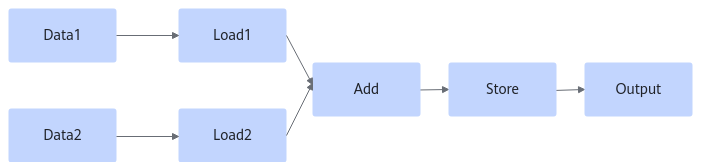
According to the memory semantics of nodes, the Load output, Add input and output, and Store input should be located in the UB memory, and the Data output should be located in the GM memory. However, the UB memory size is limited. It is impossible to load all the Data output to the UB and then continue to perform the Add operation. However, the HintGraph phase does not focus on the memory size. Therefore, the preceding graph is correct.
In the HintGraph phase, some requirements and conventions are added for AscGraph. If these conventions cannot be met and need to be expressed, the Ascend IR of the FusedAscBackend type can be used to separate the graph into multiple AscGraphs for expression.
Continuity Conventions
- Explicit broadcast: If the broadcast operation is performed during computation, the broadcast operation must be explicitly expressed. That is, the broadcast operator must be added for graph build.
- Centralized broadcast: This operation needs to be performed immediately after the load operation if any, with no intervening operations.
- Single-axis broadcast: If multi-axis broadcast occurs, each broadcast node broadcasts at most one axis.
One Set of Loop Axes
An AscGraph can have only one set of loop axes, that is, all nodes in the graph must have the same sched.axis.
Always keep_dim for Reduction
For reduction operations, there is no keep_dims parameter. Therefore, it is always keep_dims=true.