AddRmsNormDynamicQuantFusionPass
Description
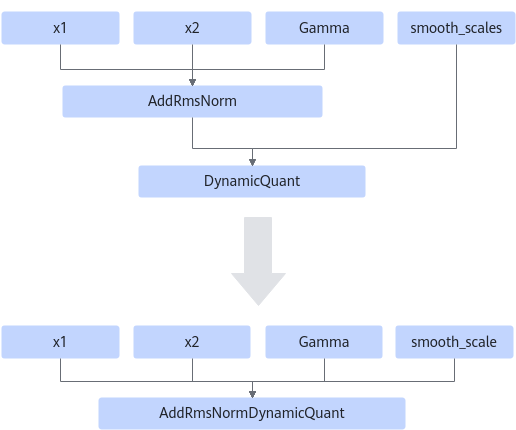
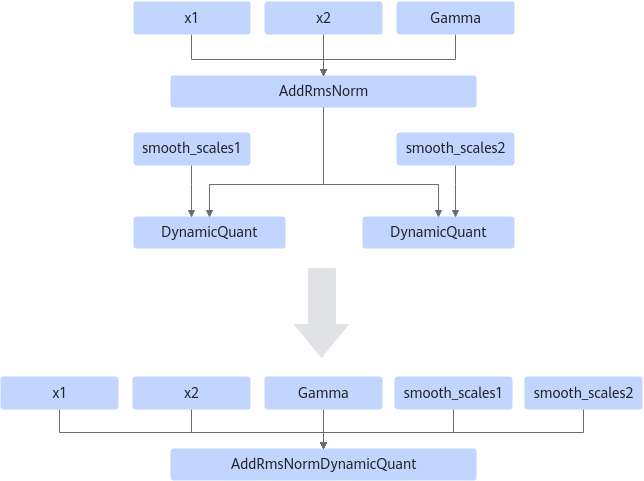
Fuses the AddRmsNorm and DynamicQuant operators that comply with the graph fusion pattern into fused operator AddRmsNormDynamicQuant. The output y of the AddRmsNorm operator is used as the first input of the DynamicQuant operator.
Pattern 1: single-channel
Pattern 2: dual-channel
Constraints
- Before fusion, the input types of the AddRmsNorm and DynamicQuant operators must be the same (fp16 or bf16).
- For the output yout of DynamicQuant:
Atlas A2 training products /Atlas A2 inference products : yout supports only the int8 quantization type.Atlas A3 training products /Atlas A3 inference products : yout supports only the int8 quantization type.
- For dtype:
- If there is a smoothing coefficient, the data type of DynamicQuant's smooth_scales must be the same as that of AddRmsNorm's x1 input.
- For shapes:
- The shape of gamma must be 1D, and its size must match the last dimension of the inputs x1 and x2, that is, gamma.shape = [x1.shape[-1]].
- For attr:
Ascend 950PR /Ascend 950DT : dst_type supports only DT_INT8, DT_HIFLOAT8, DT_FLOAT8_E4M3FN and DT_FLOAT8_E5M2.Atlas A2 training products /Atlas A2 inference products : dst_type supports only DT_INT8.Atlas A3 training products /Atlas A3 inference products : dst_type supports only DT_INT8.- In dual-channel pattern, DynamicQuant0 must have the same dst_type as DynamicQuant1.
Applicable Products
Parent topic: Graph Fusion Patterns