SplitConvConcatFusionPass
Description
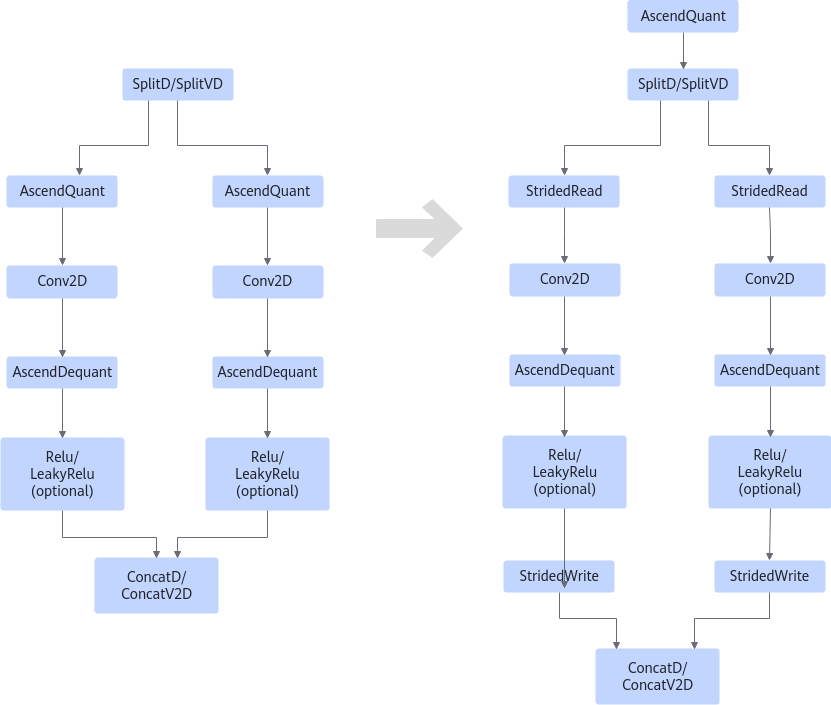
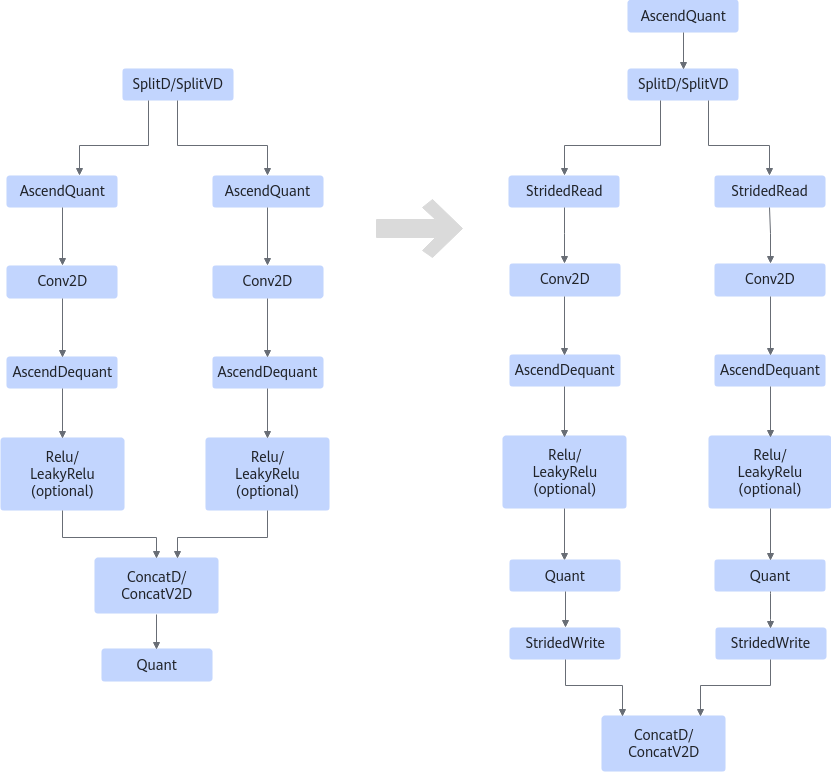
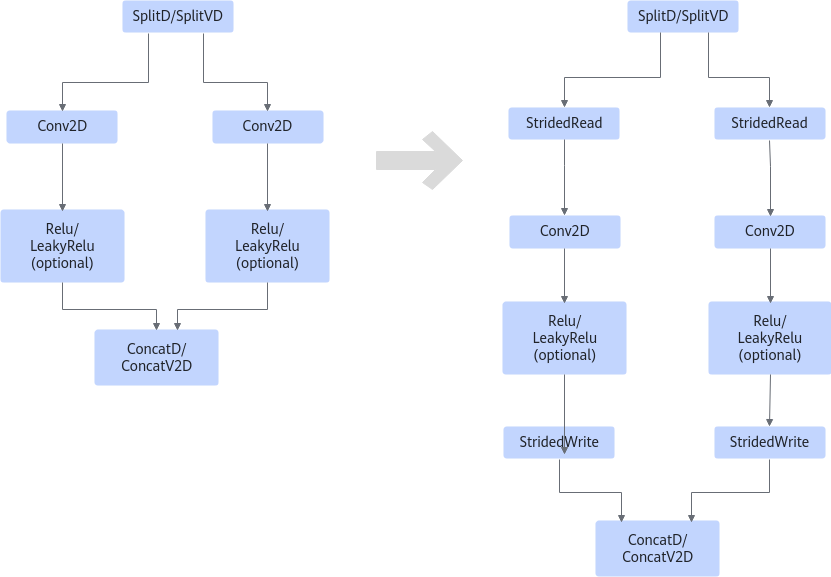
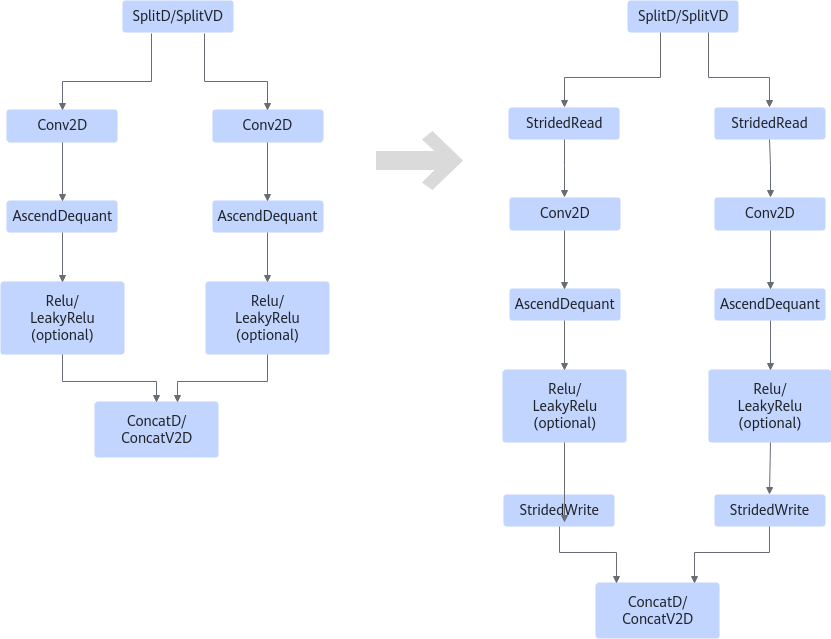
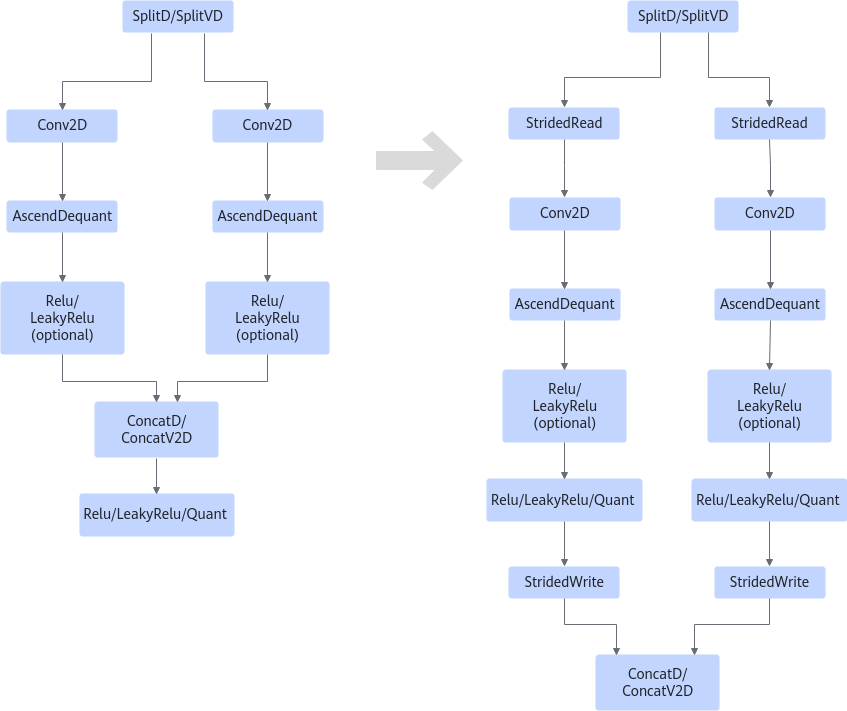
The following fusion scenarios are supported:
Scenario 1
- If the output node of ConcatD/ConcatV2D is not Quant, the fusion scenario is as follows:
- If the output node of ConcatD/ConcatV2D is Quant, the fusion scenario is as follows:
Scenario 2
- If the output node of ConcatD/ConcatV2D is not Relu/LeakyRelu/Quant, the fusion scenario is as follows:
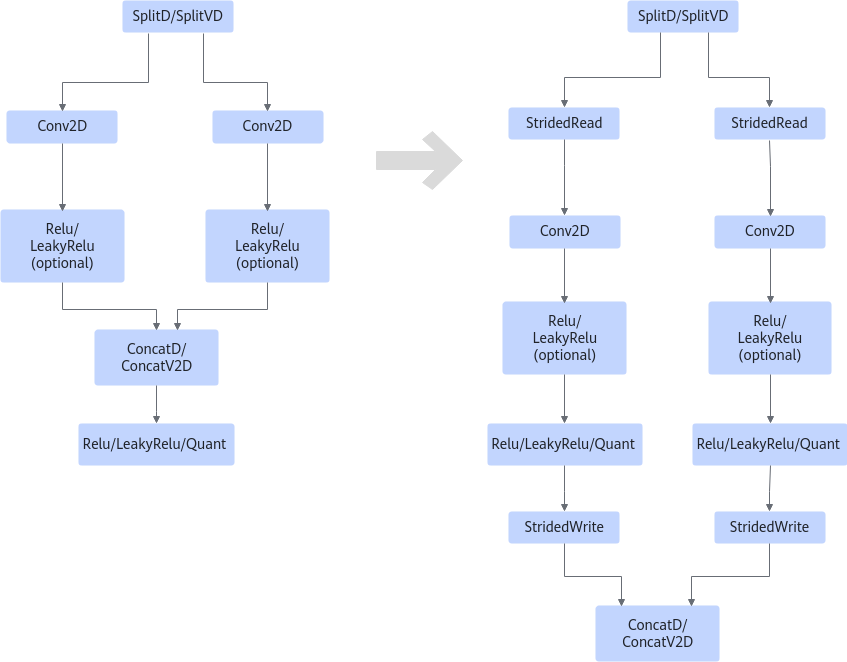
Scenario 3
Constraints
- ConcatD/ConcatV2D has at least two different input nodes.
- The dim axis of SplitD/SplitVD output and ConcatD/ConcatV2D input (except the last input) must be the C axis, and the C axis must be aligned according to data type.
- If the original dtype is fp16 or float, the value of dim C must be a multiple of 16.
- If the original dtype is int8, the value of dim C must be a multiple of 32.
- If the original dtype is int4, the value of dim C must be a multiple of 64.
- All ConcatD/ConcatV2D inputs are 4D and the input format is NCHW or NHWC.
- SplitD/SplitVD has at least two different output nodes.
- The number of input channels of ConcatD/ConcatV2D is the same as the number of output channels of SplitD/SplitVD.
- The AscendQuant operators connected to SplitD/SplitVD must have the same attributes including scale, offset, and sqrt_mode.
- This pass will not be applied if any output of ConcatD/ConcatV2D connects to a NETOUTPUT node and its primary or storage format is FORMAT_NC1HWC0. This pass will not be applied if any output of ConcatD/ConcatV2D feeds into a QUANT, LEAKYRELU, or RELU node, and that node's output in turn connects to a NETOUTPUT node whose primary or storage format is FORMAT_NC1HWC0.
- The input of SplitD/SplitVD must not be empty, and its first input node must not be a Data or RefData node.
Parent topic: Graph Fusion Patterns