RelayAttentionOperation
Applicable Products
|
Hardware Model |
Supported |
|---|---|
|
Atlas 350 accelerator cards |
x |
|
|
√ |
|
|
√ |
|
|
x |
|
|
x |
|
|
x |
Description
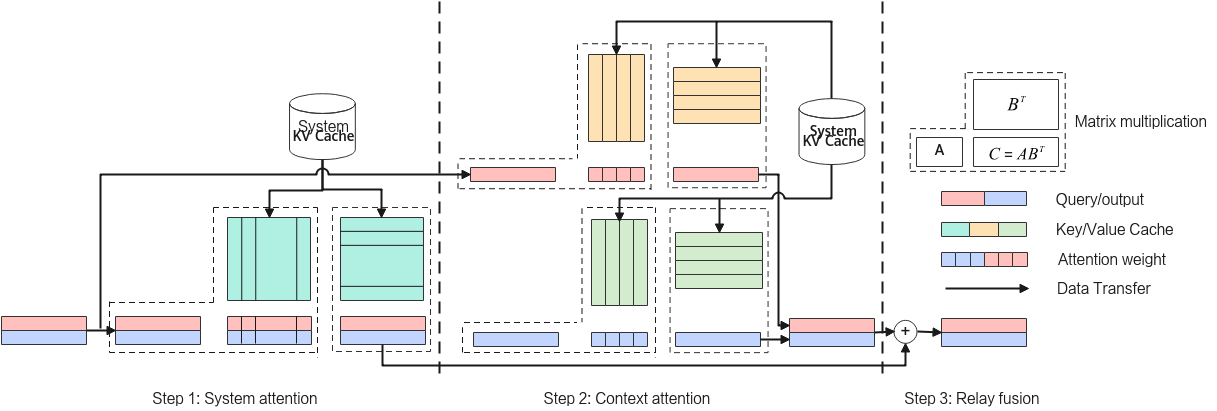
The core innovation of the RelayAttention algorithm is to group the matrix-vector multiplication corresponding to the system prompt into matrix-matrix multiplication, allowing the hidden state (key-value pair) of the system prompt to be read from the DRAM only once for a batch of input tokens, in this way, a large quantity of redundant memory accesses in existing causal attention calculation algorithms for processing system prompts are eliminated, and generation quality is maintained while efficiency is improved, and model retraining is not required.
Operator Context
Definition
1 2 3 4 5 6 7 8 9 10 11 |
struct RelayAttentionParam { int32_t headNum = 0; float qkScale = 1; int32_t kvHeadNum = 0; enum MaskType : int { MASK_TYPE_UNDEFINED = 0, MASK_TYPE_NORM, }; MaskType maskType = MASK_TYPE_UNDEFINED; uint8_t rsv[32] = {0}; }; |
Parameters
|
Member |
Type |
Default Value |
Description |
|---|---|---|---|
|
headNum |
int32_t |
0 |
Number of heads The value of headNum must be greater than 0. |
|
qkScale |
float |
1.0 |
Tor value of the operator |
|
kvHeadNum |
int32_t |
0 |
Number of kvheads. The value range is [0, 8]. The value of kvHeadNum can be either of the following:
|
|
maskType |
MaskType |
MASK_TYPE_UNDEFINED |
Mask type |
|
rsv[32] |
uint8_t |
{0} |
Reserved. |
Input
|
Parameter |
Dimension |
Data Type |
Format |
CPU or NPU |
Description |
|---|---|---|---|---|---|
|
query |
[B, qHiddenSize] |
float16/bf16 |
ND |
NPU |
Query matrix. |
|
key |
[B, [S1, N, D]] [B, [S1, N*D]] |
float16/bf16 |
ND |
CPU |
Non-shared key matrix, which is a TensorList. You can choose whether to combine axes. |
|
value |
[B, [S1, N, D]] [B, [S1, N*D]] |
float16/bf16 |
ND |
CPU |
Non-shared value matrix, which is a TensorList. You can choose whether to combine axes. |
|
keyShare |
[BS, [S2, N, D]] [BS, [S2, N*D]] |
float16/bf16 |
ND |
CPU |
Shared key matrix, which is a TensorList. You can choose whether to combine axes. |
|
valueShare |
[BS, [S2, N, D]] [BS, [S2, N*D]] |
float16/bf16 |
ND |
CPU |
Shared value matrix, which is a TensorList. You can choose whether to combine axes. |
|
attentionMask |
- |
float16/bf16 |
ND |
NPU |
Reserved input tensor. |
|
seqLen |
[B] |
int32 |
ND |
CPU |
qseqlen list. |
|
kvSeqLen |
[B] |
int32 |
ND |
CPU |
kvseqlen list. |
|
kvShareMap |
[B] |
int32 |
ND |
CPU |
Array of the mapping between batches and shared groups. If there is no shared group, the value is -1. |
|
kvShareLen |
[BS] |
int32 |
ND |
CPU |
Array of the actual length of the shared group. |
Output
|
Parameter |
Dimension |
Data Type |
Format |
CPU or NPU |
|---|---|---|---|---|
|
out |
[B, qHiddenSize] |
float16/bf16 |
ND |
NPU |
Description
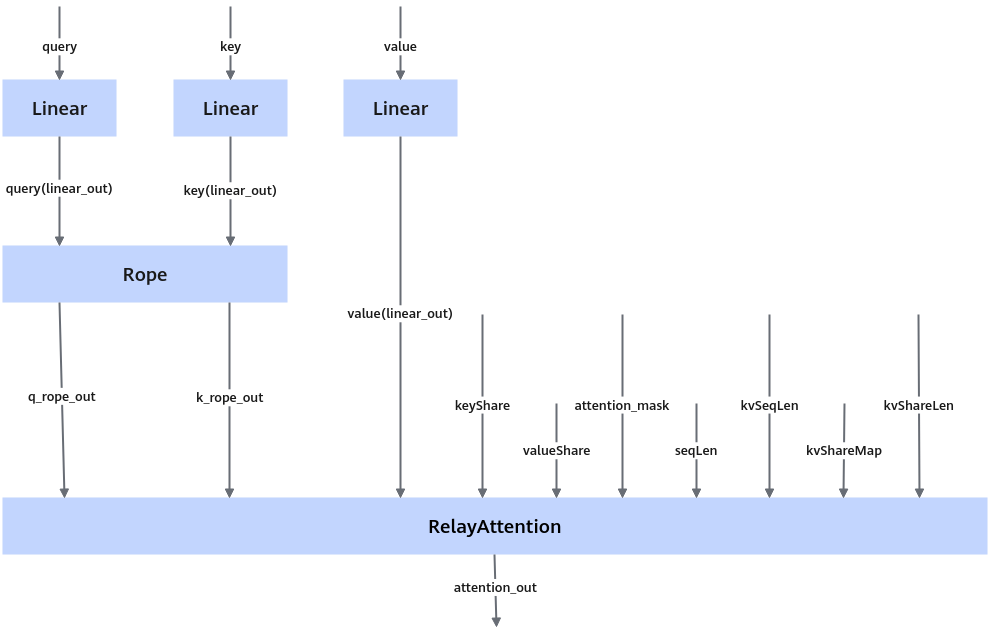
- Input key, value, keyShare, and valueShare are TensorLists. B and BS in these input tensors are level-2 pointer dimensions. Take key as an example. It is a list of size [B], which stores B pointers. Each pointer points to a tensor of size [S1, N, D] (or [S1, N × D]).
- B indicates the batch. The value range is (0, 60]. BS indicates the number of shared groups. S1 indicates the length that is not shared. S2 indicates the shared length. N indicates kvHeadNum. D indicates headSize.
- CPU indicates that the input tensor is a host tensor. When an operator is passed, the tensor needs to be bound. NPU indicates that the input tensor is a device tensor.
- Both key and value must be set to a combined axis or a non-combined axis at the same time. The same rule applies to keyShare and valueShare. That is, the dimensions of key and value are the same, and the dimensions of keyShare and valueShare are the same.
- The input tensor must be of type float16 or bf16.
- Currently, maskType can be set to MASK_TYPE_UNDEFINED only. Therefore, attentionMask is a reserved API and must be passed. Only the data type is restricted.