Fusion of Matmul and Add
Applicable Products
Hardware Model |
Supported |
Remarks |
|---|---|---|
Atlas 350 accelerator cards |
x |
- |
√ |
- |
|
√ |
- |
|
x |
- |
|
x |
- |
|
√ |
The input and output tensors of the bf16 data type are not supported. |
Description
Fuses matmul and add. This function is similar to the bias addition in function 1 but performs better.
Formula
Multiplies tensors A (x) and B (weight), adds the bias matrix, and outputs tensor C.

Parameters
Member |
Value Range |
Remarks |
|---|---|---|
transposeA |
false/true |
If this parameter is set to true, some scenarios are not supported. For details, see Specifications. |
transposeB |
false/true |
- |
hasBias |
true |
- |
outDataType |
ACL_DT_UNDEFINED |
- |
enAccum |
false |
- |
matmulType |
MATMUL_UNDEFINED |
- |
quantMode |
QUANT_UNDEFINED |
- |
Input
Parameter |
Dimension |
Data Type |
Format |
Description |
|---|---|---|---|---|
x |
[m, k]/[batch, m, k] |
float16/bf16 |
ND |
Matrix A for matrix multiplication. |
weight |
[k, n]/[batch, k, n] |
float16/bf16 |
ND |
Weight of matrix B for matrix multiplication. |
bias |
[1, n]/[n]/[batch, n] |
float |
ND |
Added bias matrix. |
Output
Parameter |
Dimension |
Data Type |
Format |
Description |
|---|---|---|---|---|
output |
[m, n]/[batch, m, n] |
float16/bf16 |
ND |
Matrix multiplication result. |
Specifications
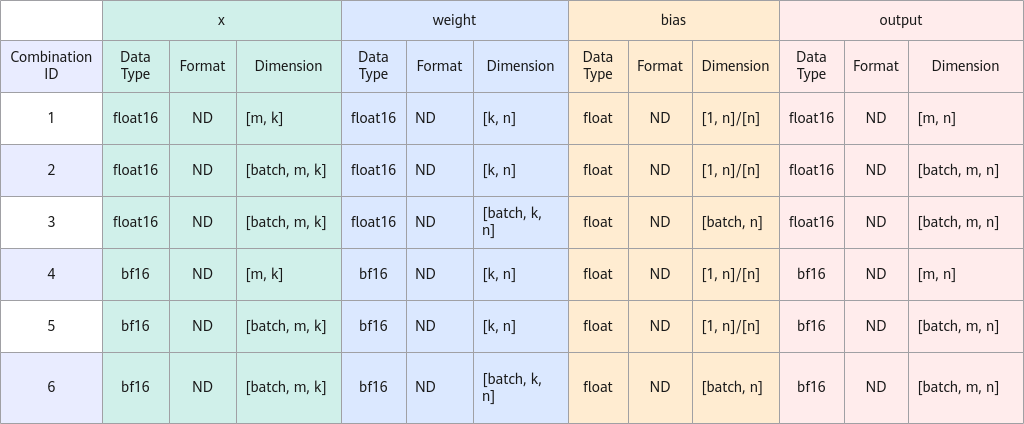
If transposeA is set to true, combinations 2 and 5 are not supported.
OP Usage and Typical Scenarios
// Parameter construction
atb::infer::LinearParam param;
param.transposeA = false;
param.transposeB = false;
param.hasBias = true;
param.outDataType = ACL_DT_UNDEFINED;
param.enAccum = false;
param.matmulType = MATMUL_UNDEFINED;
param.quantMode = QUANT_UNDEFINED;
# Example
>>> x
tensor([[1, 2],
        [3, 4]])
>>> weight
tensor([[1, 2, 3],
        [4, 5, 6]])
>>> bias
tensor([1, 2, 3])
>>> output
tensor([[10, 14, 18],
        [20, 28, 36]])
# 10 = 1 * 1 + 2 * 4 + 1
# 14 = 1 * 2 + 2 * 5 + 2
# 18 = 1 * 3 + 2 * 6 + 3
# 20 = 3 * 1 + 4 * 4 + 1
# 28 = 3 * 2 + 4 * 5 + 2
# 36 = 3 * 3 + 4 * 6 + 3
Function Constraints
- Some scenarios are not supported when transposeA is set to true.
- hasBias = true.
- outDataType = ACL_DT_UNDEFINED.
- enAccum = false.