AllGatherVOperation
Applicable Products
Hardware Model |
Supported |
|---|---|
Atlas 350 accelerator cards |
x |
x |
|
√ |
|
x |
|
√ |
|
x |
Description
Gathers data from multiple devices, concatenates the data along the dim 0 according to the order of their ranks, and then distributes the full result back to each device. Supports varying data lengths across different devices.
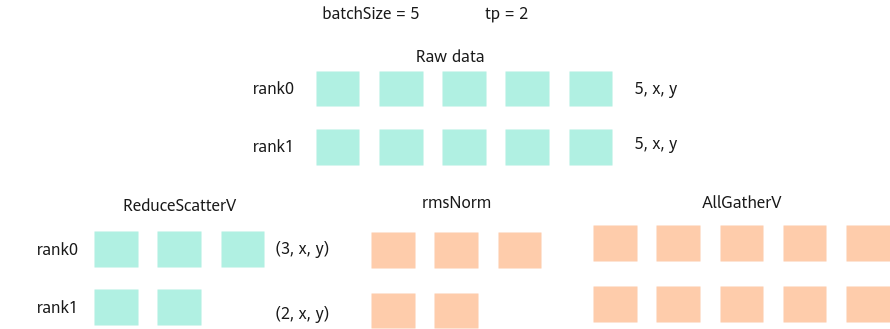
In inference tasks, the batch size may not be exactly divided by the DP number. The subsequent compute operators of ReduceScatter need to process data based on the batch dimension and then perform AllGather on the processed data, as shown in Figure 1.
Example:
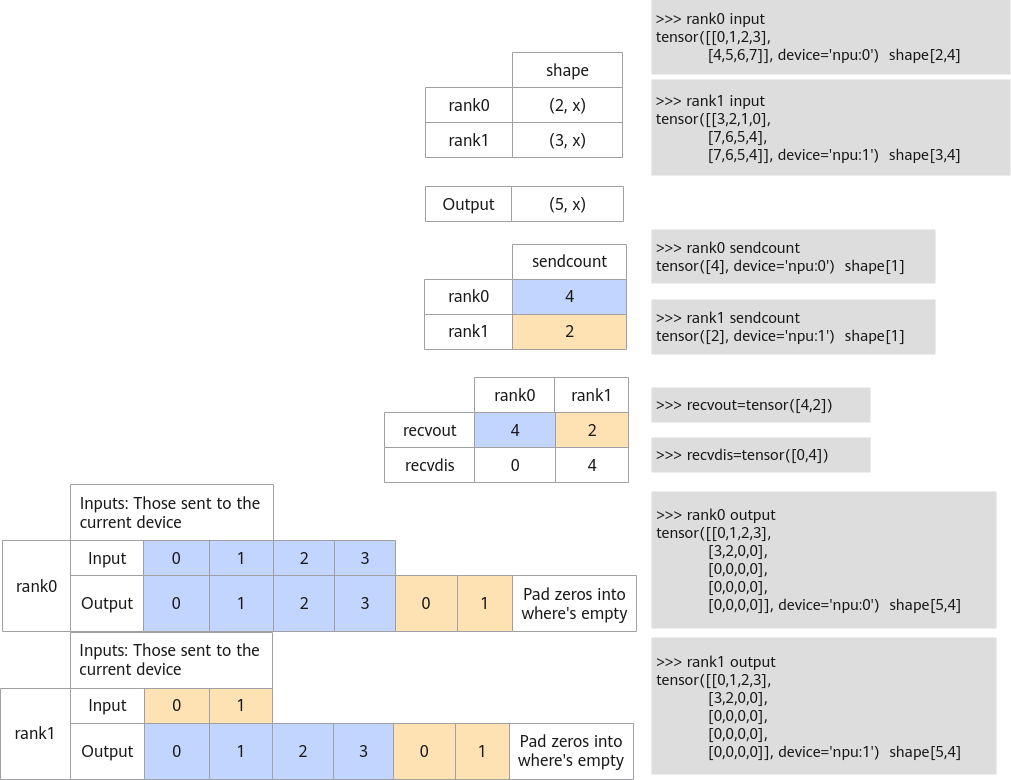
Computational process (Python):
# Compute the goldtensor.
gold_outtensor = []
for i in range(len(sendcount)):
    gold_outtensor= gold_outtensor+(tensorafters[i][0:sendcount[i]])
GoldenTensors = (torch.tensor(np.array(gold_outtensor+[0]*(sum*dim[1]-len(gold_outtensor))).reshape(sum,dim[1]), dtype=inTensorDtype))
Use Cases
In model parallelism, parameters in forward computation are fully synchronized. Forward computation can be performed only after AllGatherV is used to synchronize the parameters split to different XPUs to one XPU.
>>> rank0 input
tensor([[0,1,2,3],
        [4,5,6,7]], device='npu:0')  shape[2,4]
>>> rank0 sendcount
tensor([4], device='npu:0')  shape[1]
>>> rank1 input
tensor([[3,2,1,0],
        [7,6,5,4],
        [7,6,5,4]], device='npu:1')  shape[3,4]
>>> rank1 sendcount
tensor([2], device='npu:1')  shape[1]
>>> recvout=tensor([4,2])
>>> recvdis=tensor([0,4])
>>> y=tensor([0,1,2,3,4], device='npu:0')
>>> rank0 output
tensor([[0,1,2,3],
        [3,2,0,0],
        [0,0,0,0],
        [0,0,0,0],
        [0,0,0,0]], device='npu:0')  shape[5,4]
>>> rank1 output
tensor([[0,1,2,3],
        [3,2,0,0],
        [0,0,0,0],
        [0,0,0,0],
        [0,0,0,0]], device='npu:1')  shape[5,4]
Definition
1 2 3 4 5 6 7 8 9 10 11 | struct AllGatherVParam { int rank = -1; int rankSize = 0; int rankRoot = 0; std::string backend = "hccl"; HcclComm hcclComm = nullptr; CommMode commMode = COMM_MULTI_PROCESS; std::string rankTableFile; std::string commDomain; uint8_t rsv[64] = {0}; }; |
Parameters
Member |
Type |
Default Value |
Description |
|---|---|---|---|
rank |
int |
-1 |
Rank of the current device within the communicator. -1 indicates that no value is passed. |
rankSize |
int |
0 |
Number of devices in the communicator. Cannot be 0. |
rankRoot |
int |
0 |
Root rank for the operation. |
backend |
std::string |
hccl |
Communication computation type. Only hccl is supported. |
hcclComm |
HcclComm |
nullptr |
Address pointer obtained by the HCCL communicator API. Defaults to null. The ATB is created by users. If the user wants to manage the communicator, the communicator pointer needs to be passed. The ATB uses the passed communicator pointer to execute the communication operator. |
commMode |
CommMode |
COMM_MULTI_PROCESS |
Communication mode. When HCCL multi-threading is applied, a communicator can only be imported externally.
|
rankTableFile |
std::string |
- |
Path of the configuration file for cluster information. |
commDomain |
std::string |
- |
Communicator name used by a communication device group when there are multiple communicators. Currently, only hccl is supported. |
rsv[64] |
uint8_t |
{0} |
Reserved. |
Input
Parameter |
Dimension |
Data Type |
Format |
Mandatory |
Description |
|---|---|---|---|---|---|
x |
[dim_0, dim_1, ..., dim_n] |
hccl: float16/int8/bfloat16 |
ND |
Yes |
Input tensor. |
sendCount |
[1] |
int64 |
ND |
Yes |
Input tensor, which is the amount of data sent by the current device. The tensor of each device can be different, that is, the data length can vary. |
recvCounts |
[ranksize] |
int64 |
ND |
Yes |
Input tensor, which is the amount of data received from the corresponding index. The value is the same for each device. |
rdispls |
[ranksize] |
int64 |
ND |
Yes |
Offset of the amount of data received from the corresponding index. The value is the same for each device. rdispls[i] = n indicates that the current rank starts to receive data of rank_i from a position whose offset relative to the input start position is n. |
y |
[Sum of the dim 0 size of each device] |
float16 |
ND |
Yes |
The shape equals the sum of the first dimension's sizes (dim 0) of the concatenated tensor across all devices, which is used for shape inference. |
Output
Parameter |
Dimension |
Data Type |
Format |
Mandatory |
Description |
|---|---|---|---|---|---|
output |
[n, dim_1, ..., dim_n] |
hccl: float16/int8/bfloat16 |
ND |
No |
Output tensor, which is not written in place. Its address differs from that of the input tensor. n is the sum of the first dimension's sizes (dim 0) of the concatenated tensor across all devices, that is, the shape of y. The data type is the same as that of the input. |
Constraints
- The length of the array parameter recvCounts or rdispls is equal to rankSize.
- sendCount of the card rank is equal to recvCounts[rank].
- The shape of the first dimension of the output tensor is equal to the shape of y.
- It is supported only by
Atlas inference products andAtlas A2 training products /Atlas A2 inference products . - The dim 0 of the input tensor of each device can be different, and other dimensions must be the same.
- The sum of recvCounts array elements cannot overflow int64, and the sum of recvCounts arrays must be greater than 0.
- The value of sendCount cannot exceed the product of the shapes of all dimensions of the input tensor x.
- rank, rankSize, and rankRoot must meet the following conditions:
- 0 ≤ rank < rankSize
- 0 ≤ rankRoot < rankSize