SplitOperation
Applicable Products
Hardware Model |
Supported |
|---|---|
Atlas 350 accelerator cards |
√ |
√ |
|
√ |
|
√ |
|
√ |
|
√ |
Description
Splits an input tensor into multiple tensors along a specified dimension.
Operator Context
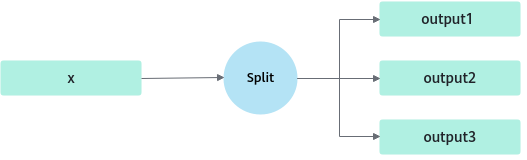
Operator Function Implementation
- Parameters:
Parameter
Description
x
Input tensor, that is, the tensor to be split.
splitNum
The value is an integer, indicating the number of splits. Currently, the value can be 2 or 3.
splitDim
Optional. The default value is 0, indicating that splitting is performed along this dimension. By default, splitting is performed along the first dimension (that is, the batch dimension).
splitSizes
Size of each output tensor in the split dimension. If this parameter is not passed, equal-length split is used. If this parameter is passed, unequal-length split is used.
- Returns:
Returns several tensors. These tensors are split from the original tensor in a specified manner.
Definition
1 2 3 4 5 6 | struct SplitParam { int32_t splitDim = 0; int32_t splitNum = 2; SVector<int32_t> splitSizes = {}; uint8_t rsv[8] = {0}; }; |
Parameters
Member |
Type |
Default Value |
Description |
|---|---|---|---|
splitDim |
int32_t |
0 |
Index of the dimension to be split. splitDim must be within the dimension range of input x. For example, if the dimension of x is xDim, the value range of splitDim is [–xDim, xDim – 1]. If splitDim is a negative number, the access starts from the highest dimension. For example, if splitDim is –1 and the number of dimensions of x is dimNum, the number of dimensions to be split is dimNum – 1. |
splitNum |
int32_t |
2 |
Number of splits. Currently, the value can be 2 or 3. The dimension of the input tensor x must be exactly divided by splitNum. When splitNum is 3, x must be of the float16 or bf16 data type. |
splitSizes |
SVector<int32_t> |
- |
Size of each output tensor in the split dimension. If this parameter is not passed, equal-length split is used. If this parameter is passed, unequal-length split is used. |
rsv[8] |
uint8_t |
{0} |
Reserved |
Input and Output (splitNum=2)
Parameter |
Dimension |
Data Type |
Format |
Description |
|---|---|---|---|---|
x |
[dim_0, ..., dim_splitDim, ..., dim_n] |
float16/int64/bf16 |
ND |
Input, up to 8 dimensions. |
output1 |
|
float16/int64/bf16 |
ND |
Output, tensor after splitting. The data type is the same as that of x. |
output2 |
|
float16/int64/bf16 |
ND |
Output, tensor after splitting. The data type is the same as that of x. |
Input and Output (splitNum=3)
Parameter |
Dimension |
Data Type |
Format |
Description |
|---|---|---|---|---|
x |
[dim_0, ..., dim_splitDim, ..., dim_n] |
float16/bf16 |
ND |
Input, up to 8 dimensions. |
output1 |
|
float16/bf16 |
ND |
Output, tensor after splitting. The data type is the same as that of x. |
output2 |
|
float16/bf16 |
ND |
Output, tensor after splitting. The data type is the same as that of x. |
output3 |
|
float16/bf16 |
ND |
Output, tensor after splitting. The data type is the same as that of x. |
Constraints
- splitDim must be within the dimension range of input x. For example, if the dimension of x is xDim, the value range of splitDim is [–xDim, xDim – 1]. If splitDim is a negative number, the access starts from the highest dimension. For example, if splitDim is –1 and the number of dimensions of x is dimNum, the number of dimensions to be split is dimNum – 1. Negative indexes are not supported when unequal-length splitting is used.
- If splitSizes is not empty, the dimension is splitNum. Each element must be greater than or equal to 1. The sum of elements is equal to the size of dim_splitDim.
- If splitSizes is empty, the dimension of the input tensor x must be divisible by splitNum.
- If splitNum is 3, the data type of x must be float16 or bf16.
- The bf16 data type is supported only by Atlas 350 accelerator cards,
Atlas A2 training products /Atlas A2 inference products , andAtlas A3 inference products /Atlas A3 training products .
API Calling Example
Input:
splitDim = 0
splitNum = 3
x = [3, 3, 3, 3, 3, 3, 3, 3, 3]
Output:
z = [3, 3, 3]
z1 = [3, 3, 3]
z2 = [3, 3, 3]