GatherOperation
Applicable Products
Hardware Model |
Supported |
Remarks |
|---|---|---|
Atlas 350 accelerator cards |
√ |
- |
√ |
- |
|
√ |
- |
|
√ |
- |
|
√ |
- |
|
√ |
The input x data type can only be float16. |
Description
Collects slices from the input tensor based on the index and combines these slices into a new tensor.
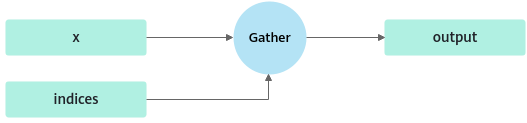
Definition
1 2 3 4 5 | struct GatherParam { int64_t axis = 0; int64_t batchDims = 0; uint8_t rsv[16] = {0}; }; |
Parameters
Member |
Type |
Default Value |
Value Range |
Mandatory |
Description |
|---|---|---|---|---|---|
axis |
int64_t |
0 |
≥ 0 and ≤ n |
Yes |
Axis from which slices are to be collected. Defaults to 0. n is the maximum index of the dimension of input x. |
batchDims |
int64_t |
0 |
≥ 0 and ≤ min(axis, m) |
Yes |
Number of batch processing dimensions. The parameter allows you to gather data slices from each element of a batch. For example, if batchDims is 1, there is an outer loop on the (axis – batchDims) axis of x. For details, see Example 2. m is the maximum index of the dimension of input indices. |
rsv[16] |
uint8_t |
{0} |
[0] |
No |
Reserved |
Input
Parameter |
Dimension |
Data Type |
Format |
Description |
|---|---|---|---|---|
x |
[dim_x_0, dim_x_1, ..., dim_x_n] |
float16/float/bfloat16/int32/uint32/int64 |
ND |
Input tensor. |
indices |
int64/int32/uint32 |
ND |
Index table. The element value range is [0, dim_x_axis). |
Output
Parameter |
Dimension |
Data Type |
Format |
Description |
|---|---|---|---|---|
output |
[dim_x_0, dim_x_1, ..., dim_x_n] |
float16/float/bfloat16/int32/uint32/int64 |
ND |
Output tensor. The data type is the same as that of x.
|
Constraints
The number of dimensions of output is less than or equal to 8. Therefore, (n + 1) + (m + 1) -1-batchdims <= 8.
API Calling Example
- Example 1:
axis = 1; batchDims = 0; The input tensor is as follows: x= [[1,2,3], [4,5,6], [7,8,9]] The indices tensor is as follows: indices=[2,0] Obtain the x data slice on the axis based on the value of the indices tensor. The output tensor is as follows: output=[[3, 1], [6, 4], [9, 7]] - Example 2:
axis= 1;
batchDims = 1;
The input tensor is as follows:
 x=  [[1,2,3],
      [4,5,6],
      [7,8,9]]
The indices tensor is as follows:
indices=[[1],
         [2],
         [0]]
batch_dims = 1 indicates that batch processing is performed on the first axis (axis 0). On axis 0, the corresponding gather processing is performed on x[i] and indices[i]. The data slice of x is obtained on the axis based on the value of indices. i is the coordinate of the batch axis. The output tensor is as follows:
output= [[2,],
         [6,],
         [7,]]
The above is equivalent to:
def gather_fun(x, indices, axis):
       batch_dims=1
       res= []
    # Perform an outer loop.
    for p,i in zip(x, indices):
         r = tf.gather(p, i, axis=axis-batch_dims)
         res.append(r)
    return tf.stack(res)