AllReduceOperation
Applicable Products
Hardware Model |
Supported |
|---|---|
Atlas 350 accelerator cards |
√ |
√ |
|
√ |
|
√ |
|
√ |
|
x |
Description
Computes the data on multiple communication cards, including addition, multiplication, minimum, and maximum calculations, and sends the result to each card.
This operator involves multi-device operations. You can configure HCCL environment variables as required. For details, see Collective Communication in CANN Environment Variables.
Application Scenarios
Many-to-many: The same Reduce operation (sum, min, max, or prod) is performed on all nodes, and the result obtained by the data reduction operation of all nodes is sent to all nodes (broadcast).
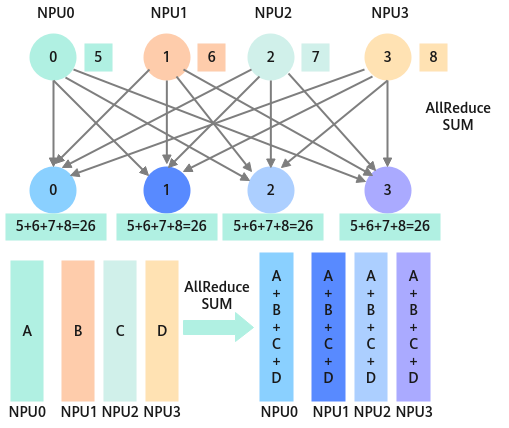
Application scenarios:
- Reduce operation in the combination of broadcast and reduce in AllReduce.
- Reduce operation in the ReduceScatter combination.
- The master node in the distributed training parameter server structure broadcasts data to the worker node, and then reduces data from the worker node to the master node.
Example:
- Non-quantization scenario (rankSize=2):
- Scenario 1: allReduce sum
x=[-4,-50]
output=[-8,-100]
npu1:
x=[-4,-50]
output=[-8,-100]
- Scenario 2: allReduce max
x=[4,20]
output=[10,50]
npu1:
x=[10,50]
output=[10,50]
- Scenario 3: allReduce min
x=[3,100]
output=[3,20]
npu1:
x=[3,20]
output=[3,20]
- Scenario 4: allReduce prod
x=[-93,-48]
output=[8649,2304]
npu1:
x=[-93,-48]
output=[8649,2304]
- Scenario 1: allReduce sum
- Quantization scenario: Quantization transmission (rankSize=2) is performed during allReduce sum.
- Quantization calculation formula:
- Scenario 1: QUANT_TYPE_PER_TENSOR quantizes the entire tensor.
x=[1,2,3,4,5,6,7,8,9,10,11,12,13,14,15,16]
scale=[1]
offset=[0]
output=[2,4,6,8,10,12,14,16,18,20,22,24,26,28,30,32]
- Scenario 2: QUANT_TYPE_PER_CHANNEL quantizes each channel in the tensor.
x=[1,2,3,4,5,6,7,8,9,10,11,12,13,14,15,16]
scale=[1,1,1,1,1,1,1,1,1,1,1,1,1,1,1,1]
offset=[0]
output=[2,4,6,8,10,12,14,16,18,20,22,24,26,28,30,32]

Definition
1 2 3 4 5 6 7 8 9 10 11 12 13 14 15 16 17 18 19 20 21 | struct AllReduceParam { enum QuantType : int { QUANT_TYPE_UNQUANT = 0, QUANT_TYPE_UNDEFINED = 0, QUANT_TYPE_PER_TENSOR = 1, QUANT_TYPE_PER_CHANNEL = 2, QUANT_TYPE_MAX = 3, }; int rank = 0; int rankSize = 0; int rankRoot = 0; std::string allReduceType = "sum"; std::string backend = "hccl"; HcclComm hcclComm = nullptr; CommMode commMode = COMM_MULTI_PROCESS; std::string rankTableFile; std::string commDomain; QuantType quantType = QUANT_TYPE_UNDEFINED; aclDataType outDataType = ACL_DT_UNDEFINED; uint8_t rsv[64] = {0}; }; |
Parameters
Member |
Type |
Default Value |
Value Range |
Mandatory |
Description |
|---|---|---|---|---|---|
rank |
int |
0 |
[0, rankSize-1] |
Yes |
Rank of the current device within the communicator. |
rankSize |
int |
0 |
- |
Yes |
Number of communication cards |
rankRoot |
int |
0 |
[0, rankSize-1] |
Yes |
Root rank for the operation. |
allReduceType |
string |
sum |
sum prod max min |
Yes |
Computation type. The value can be sum, prod, max, or min. allReduceType indicates the reduce operation type (OperationType) of collective communication. For details, see HcclReduceOp in Huawei Collective Communication Library (HCCL). prod (multiplication) is not supported for Atlas 350 accelerator cards. |
backend |
string |
hccl |
lccl/hccl |
Yes |
Communication computation type. Only hccl and lccl are supported. The LCCL function will be deleted in later versions. You are advised to use the HCCL function.
|
hcclComm |
HcclComm |
nullptr |
- |
No |
Pointer to the HCCL communicator. By default, this parameter is left blank. The ATB is created by users. If the user wants to manage the communicator, the communicator pointer needs to be passed. The ATB uses the passed communicator pointer to execute the communication operator. |
commMode |
CommMode |
COMM_MULTI_PROCESS |
|
No |
Communication mode. For details, see CommMode. In the scenario where hccl multi-thread is applied, a communicator can only be imported externally. |
rankTableFile |
string |
- |
- |
No |
Path of the configuration file for cluster information, which applies to single-node and multi-node communication scenarios. Currently, only the HCCL backend is supported. If a rank table is configured for a single-node system, the rank table is used to initialize the communicator. For details, see 《HCCL集合通信库》中的“ranktable文件配置资源信息”章节. |
commDomain |
string |
- |
- |
No |
Communicator name used by a communication device group when there are multiple communicators. When backend is set to lccl and commMode is multi-process, commDomain must be set to a number ranging from 0 to 65535. When commMode is multi-thread, deterministic computing is not supported. In this case, LCCL_DETERMINISTIC must be set to 0 or false. In the multi-process/multi-thread multi-communicator concurrency scenario, LCCL_PARALLEL must be set to 1 or true. After the multi-communicator parallelism is used, LCCL_PARALLEL must be set to 0 or false. Otherwise, the performance in basic scenarios deteriorates. The memory size of the communicator can be set for performance optimization. The format is commDomain:commDomain size (MB). For example, 0:400. When the configurations of multiple operators in the same communicator conflict, the configuration of the first operator executed in the communicator is used. Restriction: The default value is 200. Currently, the value cannot be less than 200. |
quantType |
QuantType |
QUANT_TYPE_UNQUANT |
|
No |
Quantization type. QUANT_TYPE_UNQUANT: default value. QUANT_TYPE_UNDEFINED: default value QUANT_TYPE_PER_TENSOR: quantization of the entire tensor QUANT_TYPE_PER_CHANNEL: quantization of each channel in the tensor. QUANT_TYPE_MAX: maximum value of enumerated types |
outDataType |
aclDataType |
ACL_DT_UNDEFINED |
|
No |
|
rsv[64] |
uint8_t |
{0} |
[0] |
No |
Reserved |
Note: When multiple LCCL communicators are running concurrently, the maximum communication data volume cannot exceed 100 MB. If the data volume is greater than 1 MB, the performance deteriorates. During concurrent communication, the bandwidth is shared and the performance deteriorates. LCCL multi-communicator parallelism is incompatible with deterministic computing. After deterministic computing is enabled, this function becomes invalid.
Function Input and Output Description
Parameter |
Dimension |
Data Type |
Format |
Description |
|---|---|---|---|---|
x |
[dim_0, dim_1, ..., dim_n] |
|
ND |
Input tensor |
output |
[dim_0, dim_1, ..., dim_n] |
|
ND |
Output tensor. |
Input and Output (quantType = QUANT_PER_Tensor)
Parameter |
Dimension |
Data Type |
Format |
Description |
|---|---|---|---|---|
x |
[dim_0, dim_1, ..., dim_n] |
int8 |
ND |
Input tensor. The value of the last dimension n is an integer multiple of 16. |
scale |
[1] |
float16 |
ND |
Input. The elements in scale must be scalars. |
offset |
[1] |
float16 |
ND |
Input. The elements in offset must be scalars. |
y |
[dim_0, dim_1, ..., dim_n] |
float16 |
ND |
Quantization output result. The shape of x is the same as that of y. |
Input and Output (quantType = QUANT_PER_Channel)
Parameter |
Dimension |
Data Type |
Format |
Description |
|---|---|---|---|---|
x |
[dim_0, dim_1, ..., dim_n] |
int8 |
ND |
Input tensor. The value of the last dimension n is an integer multiple of 16. n cannot be greater than 4194304. |
scale |
[1, n] or [n] |
float16 |
ND |
Input. The element in scale cannot be 0. The size of the last dimension n is an integer multiple of 16. |
offset |
[1] |
float16 |
ND |
Input. The elements in offset must be scalars. |
y |
[dim_0, dim_1, ..., dim_n] |
float16 |
ND |
Quantization output result. The shape of x is the same as that of y. |
Constraints
rank, rankSize, and rankRoot must meet the following conditions:
- 0 ≤ rank < rankSize
- 0 ≤ rankRoot < rankSize

- If there are multiple users, ATB_SHARE_MEMORY_NAME_SUFFIX (see ATB Environment Variables) needs to be used to distinguish the shared memory and synchronize initialization information.
- When the communication operator of the ATB exits abnormally, run the following commands to clear the residual data to avoid affecting subsequent operations.
rm -rf /dev/shm/sem.lccl*
rm -rf /dev/shm/sem.hccl*
ipcrm -a
- Currently, multiple HCCP process instances cannot run on a single device, and multiple communication operators cannot run on a single device at the same time. For example, when a communication operator is running, multiple models cannot run on the same card.