AllToAllOperation
Applicable Products
|
Hardware Model |
Supported |
|---|---|
|
Atlas 350 accelerator cards |
x |
|
|
√ |
|
|
√ |
|
|
x |
|
|
x |
|
|
x |
Description
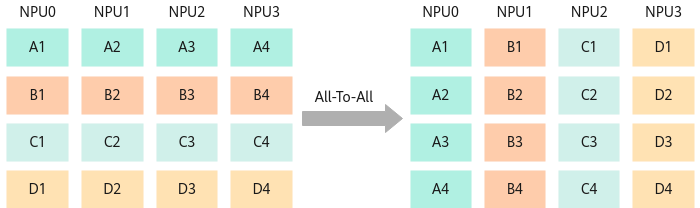
Sends data of the same amount (the input is divided into rankSize parts) to all devices in the communicator, and receives data of the same amount from all devices. As shown in the following figure, when rankSize=4, each device evenly divides its data into rankSize parts and sends the data to other devices.
Computational process (Python):
1 2 3 4 5 6 7 8 9 10 |
goldenTensors = [] for i in range(rankSize): golden_out = [] for j in range(rankSize): golden_out_list = intensors[j].reshape(-1).tolist() # intensors[j] indicates the intensor on the jth device, which is considered as a one-dimensional vector during computation. split = golden_out_list[i*len(golden_out_list) // rankSize:(i+1)*len(golden_out_list) // rankSize] golden_out += split golden_out_tensor = torch.tensor(golden_out).reshape(shape) # golden_out_tensor is the output tensor of the ith device. The output shape is the same as the input tensor. goldenTensors.append(golden_out_tensor) return [goldenTensors[rank].cpu()] |
Operator Context
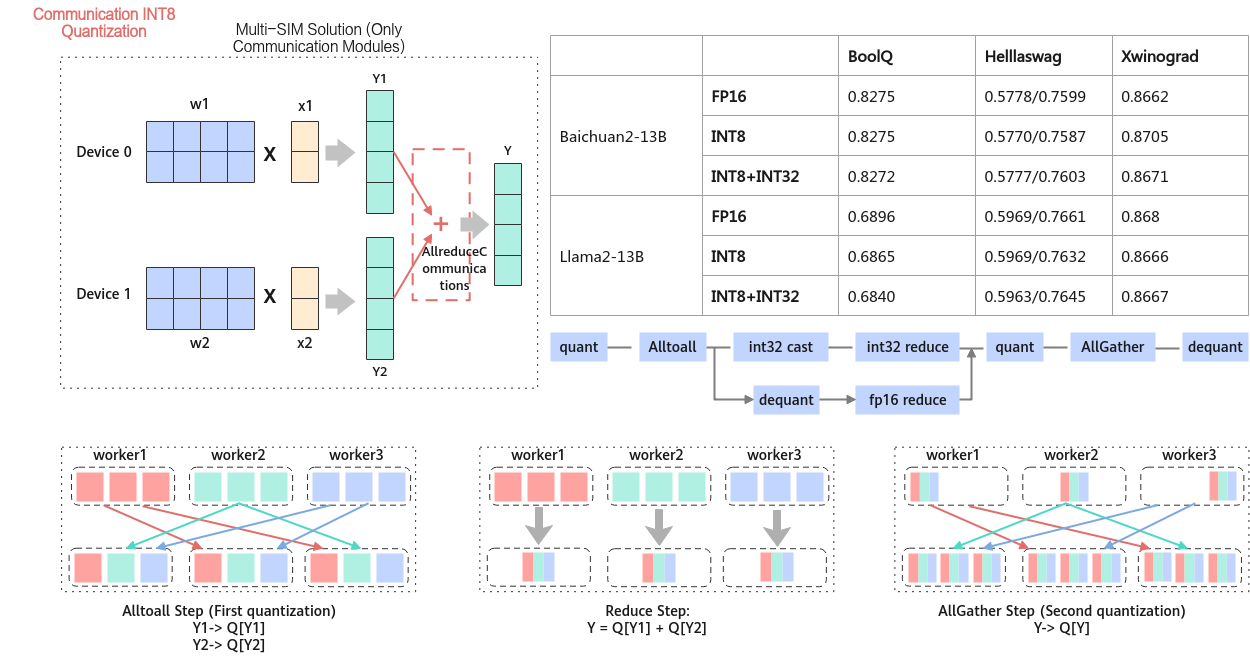
Input the quantized tensor X of int8 and send it to each node through AllToAll. (In this example, int8 is used for communication, which improves the communication speed.)
Then, the sum operation of reduce is used to sum up X, the int8 data is dequantized to the float16 data, and AllGather is used for communication to transmit the calculation result to each node.
Application Scenarios
Send data to each node in many-to-many mode. AllToAll is an extension of AllGather. Compared with AllGather, different AllToAll nodes collect different data from a node.
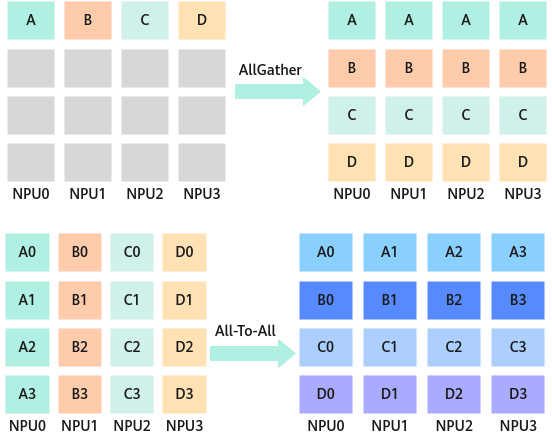
It applies to model parallelism, matrix transposition in model parallelism, and matrix transposition from data parallelism to model parallelism.
Definition
1 2 3 4 5 6 7 8 9 10 11 12 |
struct AllToAllParam { int rank = 0; int rankSize = 0; int rankRoot = 0; std::string backend = "hccl"; HcclComm hcclComm = nullptr; CommMode commMode = COMM_MULTI_PROCESS; std::string rankTableFile; std::string commDomain; bool transpose = false; uint8_t rsv[62] = {0}; }; |
Parameters
|
Member |
Type |
Default Value |
Description |
|---|---|---|---|
|
rank |
int |
0 |
Rank of the current device within the communicator. |
|
rankSize |
int |
0 |
Number of devices. |
|
rankRoot |
int |
0 |
Root rank for the operation. |
|
backend |
std::string |
hccl |
Communication computation type. hccl and lccl are supported. The LCCL function will be deleted in later versions. You are advised to use the HCCL function. If backend is set to lccl, for Atlas 200T A2 Box16 heterogeneous subrack, the communicator can be created only among the first eight or last eight devices. A communicator that contains both the first eight and last eight devices is not supported. |
|
hcclComm |
HcclComm |
nullptr |
Pointer to the HCCL communicator. By default, this parameter is left blank. The ATB is created by users. If the user wants to manage the communicator, the communicator pointer needs to be passed. The ATB uses the passed communicator pointer to execute the communication operator. |
|
commMode |
CommMode |
COMM_MULTI_PROCESS |
Communication mode. For details, see CommMode. In the scenario where hccl multi-thread is applied, a communicator can only be imported externally. |
|
rankTableFile |
std::string |
- |
Path of the configuration file for cluster information, which applies to single-node and multi-node communication scenarios. Currently, only the HCCL backend is supported. If a rank table is configured for a single-node system, the rank table is used to initialize the communicator. |
|
commDomain |
std::string |
- |
Communicator name used by a communication device group when there are multiple communicators. When backend is set to lccl and commMode is multi-process, commDomain must be set to a number ranging from 0 to 65535. When commMode is multi-thread, deterministic computing is not supported. In this case, LCCL_DETERMINISTIC must be set to 0 or false. For multi-process/multi-thread multi-communicator concurrency, LCCL_PARALLEL must be set to 1 or true. If multi-communicator parallelism is no longer needed, set LCCL_PARALLEL to 0 or false to prevent performance deterioration in basic scenarios. The memory size of the communicator can be set for performance optimization. The format is commDomain:commDomain size (MB). For example, 0:400. When the configurations of multiple operators in the same communicator conflict, the configuration of the first operator executed in the communicator is used. Restriction: The default value is 200. Currently, the value cannot be less than 200. |
|
transpose |
bool |
false |
Transposes the input based on the communication result. Currently, only lccl is supported. |
|
rsv[62] |
uint8_t |
{0} |
Reserved |
Input/Output in Basic Scenarios
transpose is set to false.
|
Parameter |
Dimension |
Data Type |
Format |
Description |
|---|---|---|---|---|
|
x |
[dim_0, dim_1, ..., dim_n] |
float16/float/int8/int16/int32/int64/bf16 |
ND |
Input tensor |
|
output |
[dim_0, dim_1, ..., dim_n] |
float16/float/int8/int16/int32/int64/bf16 The data type is the same as that of the input. |
ND |
Output tensor with the same dimensions as the input. |
Input/Output in Transpose Scenarios
transpose is set to true.
|
Parameter |
Dimension |
Data Type |
Format |
Description |
|---|---|---|---|---|
|
x |
[b, w] |
float16/bf16/int8 |
ND |
Input tensor. |
|
output |
[b*rankSize, w/rankSize] |
float16/bf16/int8 |
ND |
Output tensor. |
Constraints
- When the backend is lccl, multi-node communication and multi-communicators are not supported, and only even rankSize is supported.
- The input tensor dimensions of each communication card are the same.
- The product of the parameter dimensions must be exactly divided by rankSize.
- During AllToAll computation, the input tensor is considered as a 1D vector, and the output shape is the same as that of the input tensor.
- The constraints on transposition are:
- w must be exactly divided by rankSize.
- w/rankSize cannot exceed 90 KB.
- The size of the x tensor cannot exceed 190 MB.
- The value of rankSize can only be 2, 4, or 8.
- rank, rankSize, and rankRoot must meet the following conditions:
- 0 ≤ rank < rankSize
- 0 ≤ rankRoot < rankSize

- If there are multiple users, ATB_SHARE_MEMORY_NAME_SUFFIX (see ATB Environment Variables) needs to be used to distinguish the shared memory and synchronize initialization information.
- When the communication operator of the ATB exits abnormally, run the following commands to clear the residual data to avoid affecting subsequent operations.
rm -rf /dev/shm/sem.lccl*
rm -rf /dev/shm/sem.hccl*
ipcrm -a