aclrtGetUserDevIdByPhyDevId
Applicability
Product |
Supported |
|---|---|
Ascend 910D AI Processor |
√ |
Atlas A3 Training Series Product |
√ |
Atlas A2 Training Series Product/Atlas 800I A2 Inference Product |
√ |
Atlas 200/500 A2 Inference Product |
√ |
Atlas Inference Series Product |
√ |
Atlas Training Series Product |
√ |
Function
Obtains the user device ID based on the physical device ID.
Prototype
1 | aclError aclrtGetUserDevIdByPhyDevId(const int32_t phyDevId, int32_t *const userDevId) |
Parameters
Parameter |
Input/Output |
Description |
|---|---|---|
phyDevId |
Input |
Physical device ID. |
userDevId |
Output |
User device ID. |
Returns
0 on success; otherwise, failure. For details, see aclError.
Relationships Between the User Device ID, Logical Device ID, and Physical Device ID
If the ASCEND_RT_VISIBLE_DEVICES environment variable is not set, the logical device ID is the same as the user device ID. In a non-container scenario, the physical device ID is the same as the logical device ID.
In the figure below, the ASCEND_RT_VISIBLE_DEVICES environment variable is set in the container scenario. The relationships between the three IDs are as follows: The device IDs set through the ASCEND_RT_VISIBLE_DEVICES environment variable are 1 and 2, and the corresponding device indexes are 0 and 1. The user device ID set through aclrtSetDevice is 0, and the corresponding device index is 0. Therefore, the user device ID 0 corresponds to the logical device ID 1, and the logical device ID 1 in the container is mapped to the physical device ID 6. Finally, the physical device with ID 6 is used for computation.
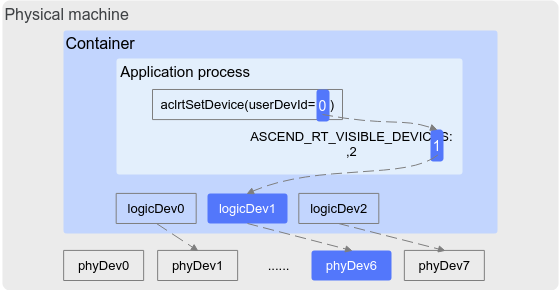
For details about ASCEND_RT_VISIBLE_DEVICES, see Environment Variables.