aclCompileOpt
Definition
1 2 3 4 5 6 7 8 9 10 11 12 13 14 15 16 17 18 19 |
typedef enum { ACL_PRECISION_MODE, // Operator precision mode of a network model. ACL_AICORE_NUM, // Sets the number of AI Cores used for model compilation. ACL_AUTO_TUNE_MODE, // Sets the operator auto tuning mode. ACL_OP_SELECT_IMPL_MODE, // Sets the operator implementation mode. ACL_OPTYPELIST_FOR_IMPLMODE, // Lists operator types. Operators in the list are implemented in the mode specified by ACL_OP_SELECT_IMPL_MODE. ACL_OP_DEBUG_LEVEL, // Enables TBE operator debug during operator compilation. ACL_DEBUG_DIR, // Sets the debug directory, for saving the files generated during model conversion and network migration, including the .o, .json, and .cce files of operators. ACL_OP_COMPILER_CACHE_MODE, // Sets the disk cache mode for operator compilation. ACL_OP_COMPILER_CACHE_DIR, // Sets the disk cache directory for operator compilation. ACL_OP_PERFORMANCE_MODE, // Determines whether to compile operators in high-performance mode. ACL_OP_JIT_COMPILE, // Determines whether to compile an operator online or use a compiled operator binary file. ACL_OP_DETERMINISTIC, // Determines whether to enable deterministic computing. ACL_CUSTOMIZE_DTYPES, // Customizes the computation precision of one or more operators during model building. ACL_OP_PRECISION_MODE, // Sets the precision mode for internal operator processing. One or more operators can be specified. ACL_ALLOW_HF32, // HF32 is a precision type of the AI processor for the internal computation of operators. It is not supported in the current version. ACL_PRECISION_MODE_V2, // Sets the operator precision mode of a network model. Compared with ACL_PRECISION_MODE, ACL_PRECISION_MODE_V2 is added in the new version, offering more precision modes and clearer semantics for the existing precision mode options. ACL_OP_DEBUG_OPTION // Currently, this parameter can only be set to oom, indicating that global memory out-of-bounds access detection is enabled. } aclCompileOpt; |
ACL_PRECISION_MODE
Sets the operator precision mode of a network model. If it is not specified, allow_fp32_to_fp16 is used by default.
- force_fp32/cube_fp16in_fp32out:
force_fp32 and cube_fp16in_fp32out have the same effect. This option indicates that the system selects different processing modes based on the operator type when the operator in the AI Core supports both the float32 and float16 data types. cube_fp16in_fp32out is newly added to the new version. For cube operators, this option has clearer semantics.
- For cube operators, the system processes the computation based on the operator implementation.
- The preferred input data type is float16 and the output data type is float32.
- If the float16 input data and float32 output data types are not supported, set both the input and output data types to float32.
- If the float32 input and output data types are not supported, set both the input and output data types to float16.
- If the float16 input and output data types are not supported, an error is reported.
- For vector compute operators, the operator precision in the original graph is float16 or bfloat16, this option forces the operator to use float32.
This option takes no effect if the original graph contains operators whose implementation on the AI Core does not support float32, for example, an operator that supports only float16. In this case, the supported float16 is used. If the operator implementation on the AI Core does not support float32 and the blocklist mode is enabled (by setting precision_reduce to false), the float32 AI CPU operator is used. If the AI CPU operator does not support float32 either, an error is reported.
- For cube operators, the system processes the computation based on the operator implementation.
- force_fp16 (default):
Forces operators in the original model to use float16, regardless of whether their original computation precision is float16, bfloat16, or float32.
- allow_fp32_to_fp16:
- For matrix operators:
- If the operator computation precision in the original graph is float32, the precision is preferentially reduced to float16. If the operator does not have a float16 implementation on the AI Core, float32 is used. If the AI Core also does not support float32 for this operator, the AI CPU operator is used for computation. If the AI CPU operator is also unsupported, an error is reported.
- If the operator computation precision in the original graph is bfloat16, the original precision is used preferentially. If the operator does not have a bfloat16 implementation on the AI Core, float32 is used. If the AI Core also does not support float32 for this operator, the precision is reduced to float16. If the AI Core also does not support float16 for this operator, the AI CPU operator is used for computation. If the AI CPU operator is also unsupported, an error is reported.
- For vector operators, the original precision is used preferentially.
- If the operator computation precision in the original graph is float32, the original precision is used preferentially. If the operator does not have a float32 implementation on the AI Core, the precision is reduced to float16. If the AI Core also does not support float16 for this operator, the AI CPU operator is used for computation. If the AI CPU operator is also unsupported, an error is reported.
- If the operator computation precision in the original graph is bfloat16, the original precision is used preferentially. If the operator does not have a bfloat16 implementation on the AI Core, float32 is used. If the AI Core also does not support float32 for this operator, the precision is reduced to float16. If the AI Core also does not support float16 for this operator, the AI CPU operator is used for computation. If the AI CPU operator is also unsupported, an error is reported.
- For matrix operators:
- must_keep_origin_dtype:
Retain the original precision.
- If the precision of an operator in the original graph is float16, and the implementation of the operator in the AI Core does not support float16 but supports only float32 and bfloat16, the system automatically uses high-precision float32.
- If the precision of an operator in the original graph is float16, and the implementation of the operator in the AI Core does not support float16 but supports only bfloat16, the AI CPU operator of float16 is used. If the AI CPU operator is not supported, an error is reported.
- If the precision of an operator in the original graph is float32, and the implementation of the operator in the AI Core does not support float32 but supports only float16, the AI CPU operator of float32 is used. If the AI CPU operator is not supported, an error is reported.
- allow_mix_precision/allow_mix_precision_fp16:
allow_mix_precision has the same effect as that of allow_mix_precision_fp16, indicating that mixed precision of float16, bfloat16, and float32 is used for neural network processing. allow_mix_precision_fp16 is newly added to the new version, which has clearer semantics for easy understanding.
For float32 and bfloat16 operators in the original model, float16 is automatically used for certain float32 and bfloat16 operators based on the built-in tuning policy, which improves system performance and reduces memory usage with minimal accuracy loss.
If this mode is configured, you can view the value of precision_reduce in the built-in tuning policy file ${INSTALL_DIR}/opp/built-in/op_impl/ai_core/tbe/config/xxx/aic-xxx-ops-info-*.json.
- If it is set to true, the operator is on the trustlist and its precision will be reduced from float32 or bfloat16 to float16.
- If it is set to false, the operator is on the blocklist and its precision will not be reduced from float32 or bfloat16 to float16. Such operators will continue to use their original precision (float32 or bfloat16).
- If an operator in the network model does not have precision_reduce configured (that is, it is in the graylist), the mixed-precision handling mechanism for the current operator follows that of the previous operator. That is, if the previous operator supports precision reduction, the current operator also supports it; if the previous operator does not allow precision reduction, the current operator does not either.
- allow_mix_precision_bf16:
Mixed precision of bfloat16 and float32 is used for neural network processing. In this mode, bfloat16 is automatically used for certain float32 operators on the original model based on the built-in tuning policy, which improves system performance and reduces memory usage with minimal accuracy loss. If the operator has neither bfloat16 nor float32 implementation on the AI Core, the AI CPU operator is used for computation. If the AI CPU operator is also unsupported, an error is reported.
If this mode is configured, you can view the value of precision_reduce in the built-in tuning policy file ${INSTALL_DIR}/opp/built-in/op_impl/ai_core/tbe/config/xxx/aic-xxx-ops-info-*.json.
- If it is set to true, the operator is on trustlist and its precision will be reduced from float32 to bfloat16.
- If it is set to false, the operator is on the blocklist and its precision will not be reduced from float32 to bfloat16.
- If an operator in the network model does not have precision_reduce configured (that is, it is in the graylist), the mixed-precision handling mechanism for the current operator follows that of the previous operator. That is, if the previous operator supports precision reduction, the current operator also supports it; if the previous operator does not allow precision reduction, the current operator does not either.
- allow_fp32_to_bf16:
- If the operator computation precision in the original graph is float32, the original precision is used preferentially. If the operator does not have a float32 implementation on the AI Core, the precision is reduced to bfloat16. If the AI Core also does not support bfloat16 for this operator, the AI CPU operator is used for computation. If the AI CPU operator is also unsupported, an error is reported.
- If the operator computation precision in the original graph is bfloat16, the original precision is used preferentially. If the operator does not have a bfloat16 implementation on the AI Core, float32 is used. If the AI Core also does not support float32 for this operator, the AI CPU operator is used for computation. If the AI CPU operator is also unsupported, an error is reported.
ACL_AICORE_NUM
Sets the number of AI Cores used for model compilation.
The setting is invalid in the current version.
ACL_AUTO_TUNE_MODE
Sets the operator auto tuning mode. Do not set this parameter because it will be deprecated. Otherwise, compatibility issues may occur in later versions.
ACL_OP_SELECT_IMPL_MODE
Sets the operator implementation mode. If it is not specified, high_precision is used by default.
- high_precision: High-precision mode.
This option sets the operator implementation mode by using the built-in configuration file, which is stored in ${INSTALL_DIR}/opp/op_impl/built-in/ai_core/tbe/impl_mode/high_precision.ini.
To ensure compatibility, this argument takes effect only for the operator list in the high_precision.ini file. This list can be used to control the effective scope of operators and ensure that the network models of earlier versions are not affected.
- high_performance (default): high-performance mode.
This option sets the operator implementation mode by using the built-in configuration file, which is stored in ${INSTALL_DIR}/opp/built-in/op_impl/ai_core/tbe/impl_mode/high_performance.ini.
To ensure compatibility, this argument takes effect only for the operator list in the high_performance.ini file. This list can be used to control the effective scope of operators and ensure that the network models of earlier versions are not affected.
- high_precision_for_all: High-precision mode.
This option sets the operator implementation mode by using the built-in configuration file, which is stored in ${INSTALL_DIR}/opp/built-in/op_impl/ai_core/tbe/impl_mode/high_precision_for_all.ini. The list in this file may be updated with the version.
This implementation mode may cause incompatibility. If an operator in the new software package sets the implementation mode (that is, an implementation mode is added for a certain operator in the configuration file), the performance of the earlier network model that uses the high_precision_for_all mode may deteriorate.
- high_performance_for_all: High-performance mode.
This option sets the operator implementation mode by using the built-in configuration file, which is stored in ${INSTALL_DIR}/opp/built-in/op_impl/ai_core/tbe/impl_mode/high_performance_for_all.ini. The list in this file may be updated with the version.
This implementation mode may cause incompatibility. If an operator in the new software package sets the implementation mode (that is, an implementation mode is added for a certain operator in the configuration file), the precision of the earlier network model that uses the high_performance_for_all mode may deteriorate.
ACL_OPTYPELIST_FOR_IMPLMODE
Sets the list of operator types (multiple operators are separated by commas). This option is used together with ACL_OP_SELECT_IMPL_MODE to specify whether the operators in the list use the high-precision or high-performance implementation mode.
ACL_OP_DEBUG_LEVEL
Enables or disables TBE operator debug during operator compilation.
The options are as follows:
- 0 (default): Disables operator debug. The operator build folder kernel_meta is not generated in the current execution path.
- 1: Enables operator debug. The kernel_meta folder is generated in the current execution path, and the operator binary file (.o), operator description file (.json), and TBE instruction mapping files (operator CCE file *.cce and python-CCE mapping file *_loc.json) are generated in the folder for subsequent analysis of AI Core errors.
For the
Ascend 950PR /Ascend 950DT , TBE instruction mapping files are not generated. - 2: Enables operator debug. The kernel_meta folder is generated in the current execution path, and the operator binary file (.o), operator description file (.json), and TBE instruction mapping files (operator CCE file *.cce and python-CCE mapping file *_loc.json) are generated in the folder for subsequent analysis of AI Core errors. Setting this option to 2 also disables build optimization and enables the CCE compiler debug function (the CCE compiler option is set to -O0-g).
For the
Ascend 950PR /Ascend 950DT , TBE instruction mapping files are not generated. - 3: Disables operator debug. The kernel_meta folder is generated in the current execution path, and the operator binary file (.o) and operator description file (.json) are generated in the folder. You can refer to these files when analyzing operator errors.
- 4: Disables operator debug. The kernel_meta folder is generated in the current execution path, and the operator binary file (.o), operator description file (.json), TBE instruction mapping file (operator CCE file *.cce), and UB fusion description file ({$kernel_name}_compute.json) are generated in the folder. These files can be used for problem reproduction and accuracy comparison during operator error analysis.
For the
Ascend 950PR /Ascend 950DT , neither TBE instruction mapping files nor UB fusion compute description files are generated.
The configuration constraints are as follows:
- When this option is set to 2, the CCE compiler is enabled, and the size of the operator kernel file (*.o) increases. In dynamic-shape scenarios, all possible shape cases are traversed during operator build, which may result in operator build failures caused by oversized operator kernel files. For such scenarios, you are advised not to enable the CCE compiler options.
The following is an example error log generated when operator build fails due to oversized operator kernel files:
message:link error ld.lld: error: InputSection too large for range extension thunk ./kernel_meta_xxxxx.o
- When the debug function is enabled, if the model contains the following MC2 operators, the *.o, *.json, and *.cce files of these operators are not generated in the operator build folder kernel_meta.
MatMulAllReduce
MatMulAllReduceAddRmsNorm
AllGatherMatMul
MatMulReduceScatter
AlltoAllAllGatherBatchMatMul
BatchMatMulReduceScatterAlltoAll
ACL_DEBUG_DIR
Sets the path (defaults to Current path of the executed application/kernel_meta) for storing debugging information files generated after operator compilation during model conversion and network migration, including the .o, .json, and .cce files. The generated files depend on the value of ACL_OP_DEBUG_LEVEL.
The directory name can contain letters, digits, underscores (_), hyphens (-), periods (.), and Chinese characters.
In addition to setting enumerated values, you can also configure the cache directory for operator compilation files by setting the environment variable ASCEND_WORK_PATH. The priorities of these methods are as follows: Setting enumerated values > Setting environment variables > Default directory. For details about how to set environment variables, see Environment Variables.
ACL_OP_COMPILER_CACHE_MODE
Sets the disk cache mode for operator compilation. This option must be used in conjunction with ACL_OP_COMPILER_CACHE_DIR.
- enable: enabled. If it is enabled, operators with the same build configurations and operator configurations will not be built repeatedly, thus accelerating the build speed.
- force: Enabled with cache forcibly refreshed. That is, the existing cache is cleared up before the operator is recompiled and added to the cache. For example, for Python changes, dependency library changes, or repository changes after operator optimization, you need to set this option to force to clear up the existing cache and then change it to enable to prevent the cache from being forcibly refreshed during each build.
- disable: disabled.
If debugging is also enabled (ACL_OP_DEBUG_LEVEL is set to a non-zero value), the system ignores the configuration of ACL_OP_COMPILER_CACHE_MODE and does not cache the compilation result in the debugging scenario.
When you enable the operator compilation cache function, you can set the disk space of the cache folder with the configuration file (the op_cache.ini configuration file is automatically generated in the path specified by ACL_OP_COMPILER_CACHE_DIR during operator compilation) or environment variables.
- Using the op_cache.ini configuration file:
If the op_cache.ini file does not exist, manually create it. Open the file and add the following information:
# Configure the file format (required). The automatically generated file contains the following information by default. When manually creating a file, enter the following information:
[op_compiler_cache]
# Limit the disk space of the cache folder on a chip, in MB. The value must be an integer and defaults to 500.
max_op_cache_size=500
# Set the percentage of the cache space to be reserved. The value range is [1, 100]. The default value is 50. For example, 80 indicates that when the cache space is insufficient, cache files will be deleted to keep 80% of the cache space available.
remain_cache_size_ratio=50
- The op_cache.ini file takes effect only when the values of max_op_cache_size and remain_cache_size_ratio in the preceding file are valid.
- If the size of the build cache file exceeds the value of max_op_cache_size and the cache file is not accessed for more than half an hour, the cache file will be aged. (Operator build will not be interrupted due to the size of the build cache file exceeding the set limit. Therefore, if max_op_cache_size is set to a small value, the size of the actual build cache file may exceed the configured value.)
- To disable the build cache aging function, set max_op_cache_size to -1. In this case, the access time is not updated when the operator cache is accessed, the operator build cache is not aged, and the default disk space of 500 MB is used.
- If multiple users use the same cache path, you are advised to use the configuration file to set the cache path. In this scenario, the op_cache.ini file affects all users.
- Using environment variables
In this scenario, the environment variable ASCEND_MAX_OP_CACHE_SIZE is used to limit the storage space of the cache folder of a chip. When the build cache space reaches the specified value and the cache file is not accessed for more than half an hour, the cache file is aged. The environment variable ASCEND_REMAIN_CACHE_SIZE_RATIO is used to set the ratio of the cache space to be reserved.
A configuration example is provided as follows:
# The ASCEND_MAX_OP_CACHE_SIZE environment variable defaults to 500, in MB. The value must be an integer.
export ASCEND_MAX_OP_CACHE_SIZE=500
# The value range of the ASCEND_REMAIN_CACHE_SIZE_RATIO environment variable is [1, 100]. The default value is 50, in percentage. For example, 80 indicates that when the cache space is insufficient, cache files will be deleted to keep 80% of the cache space available.
export ASCEND_REMAIN_CACHE_SIZE_RATIO=50
- The argument configured through environment variables takes effect only for the current user.
- To disable the build cache aging function, set the environment variable ASCEND_MAX_OP_CACHE_SIZE to -1. In this case, the access time is not updated when the operator cache is accessed, the operator build cache is not aged, and the default disk space of 500 MB is used.
If both the op_cache.ini file and environment variable are configured, the configuration items in the op_cache.ini file are read first. If neither the op_cache.ini file nor the environment variable is configured, the system default values are read: 500 MB disk space and 50% reserved cache space.
ACL_OP_COMPILER_CACHE_DIR
Sets the cache directory of operator compilation files. The default directory is $HOME/atc_data. This option must be used in conjunction with ACL_OP_COMPILER_CACHE_MODE.
The directory name can contain letters, digits, underscores (_), hyphens (-), periods (.), and Chinese characters.
If the ACL_OP_DEBUG_LEVEL option is set, the compilation cache function is enabled only when this option is set to 0.
In addition to setting enumerated values, you can also configure the cache directory for operator compilation files by setting the environment variable ASCEND_CACHE_PATH. The priorities of these methods are as follows: Setting enumerated values > Setting environment variables > Default directory. For details about how to set environment variables, see Environment Variables.
ACL_OP_PERFORMANCE_MODE
Determines whether to compile operators in high-performance mode. Do not set this parameter because it has been deprecated. Otherwise, compatibility issues may occur in later versions.
The options are as follows:
- normal: The operator is compiled with the optimal compilation performance. This mode is used by default.
- high: The operator is compiled with the highest runtime performance using the generalization strategy.
ACL_OP_JIT_COMPILE
Determines whether to compile an operator online or use the binary file of a compiled operator.
The options are as follows:
- enable: Operators are compiled online. The system performs tuning based on the obtained operator information to generate operators with improved runtime performance. In the static-shape network scenario, you are advised to set this parameter to enable.
- disable: The compiled operator binary file in the system is preferentially searched. If the file can be found, operators are not compiled anymore, which produces better compilation performance. If the file cannot be found, operators will be compiled. In the dynamic-shape network scenario, you are advised to set this parameter to disable.
The default value varies depending on the product model:
For the
For the
For the
For the
For the
For the
If it is set to disable, you need to install the operator binary package. For details, see CANN Software Installation.
ACL_OP_DETERMINISTIC
Whether to enable deterministic computing.
- 0 (default): disables deterministic computing. In this case, the results of multiple executions of an operator with the same hardware and input may be different. This is generally caused by asynchronous multi-thread executions during operator implementation, which changes the accumulation sequence of floating-point numbers.
- 1: enables deterministic computing. In this case, the results of multiple executions of an operator with the same hardware and input will be the same. However, enabling deterministic computing often slows down operator execution.
You are advised not to enable deterministic computing because it slows down operator execution and affects performance. If the execution results of a model are different for multiple times or the precision needs to be optimized, you can enable deterministic computing to assist model debugging and optimization.
ACL_CUSTOMIZE_DTYPES
Sets the path (including the file name) of the *.cfg configuration file, which lists the names or types of operators whose calculation precisions need to be specified. Each operator occupies a line. With this configuration, you can customize the computation precision of one or more operators during model compilation.
Configuration constraints:
- The path and file name can contain letters, digits, underscores (_), hyphens (-), periods (.), colons (:), and Chinese characters.
- To specify operator names in the configuration file, follow the Opname::InputDtype:dtype1,...,OutputDtype:dtype1,... format. Put each operator name in a separate line. The data types (such as dtype1 and dtype2) must correspond one-to-one to the number of inputs and outputs of the operators whose precision can be configured.
- To specify operator types in the configuration file, follow the OpType::TypeName:InputDtype:dtype1,...,OutputDtype:dtype1,... format. Put each operator type in a separate line. The data types (such as dtype1 and dtype2) must correspond one-to-one to the number of inputs and outputs of the operators whose precision can be configured. The operator type must be OpType of the Ascend IR–defined operator. For details about OpType, see How Do I Determine the Mapping Between Operators in the Original Framework Network Model and Operators Supported by the AI Processor in Ascend Tensor Compiler (ATC).
- For the same operator, if both Opname and OpType are configured, the Opname configuration is used during compilation.
- The computation precision of an operator specified by this option does not take effect if the operator is fused during model conversion.
ACL_OP_PRECISION_MODE
Sets the path and file name of the configuration file (.ini format) for setting the operator precision mode. The path and file name can contain letters, digits, underscores (_), hyphens (-), periods (.), and Chinese characters.
- high_precision
- high_performance
- enable_float_32_execution: The FP32 data type is used for internal processing of operators. In this scenario, the FP32 data type is not automatically converted to the HF32 data type. If you are using the HF32 data type for computation and find that the accuracy drop exceeds your expectation, you can enable this configuration to specify the use of FP32 for internal computation of certain operators in order to maintain accuracy.
This option is supported only by the following products:
Ascend 950PR /Ascend 950DT Atlas A2 training products /Atlas A2 inference products Atlas A3 training products /Atlas A3 inference products - enable_hi_float_32_execution: The HF32 data type is used for internal processing of operators. After this option is enabled, the FP32 data type is automatically converted to HF32. This can reduce the space occupied by data and improve performance.
This option is not supported in the current version.
- support_out_of_bound_index: indicates that the out-of-bounds verification is performed on the indices of the gather, scatter, and segment operators. The verification deteriorates the operator execution performance.
- keep_fp16: The FP16 data type is used for internal processing of operators. In this mode, the FP16 data type is not automatically converted to FP32. If FP32-based computation fails to meet performance expectations and high accuracy is not required, you can enable the keep_fp16 mode. This low-precision mode trades accuracy for performance and is not recommended.
- super_performance: Indicates ultra-high performance. Compared with high performance, the algorithm calculation formula is optimized.
Construct the op_precision.ini configuration file to set operator precision modes. Specify one precision mode per line, either by operator type (lower priority) or by node name (higher priority).
A configuration example is as follows:
[ByOpType]
optype1=high_precision
optype2=high_performance
optype3=support_of_bound_index

[ByNodeName]
nodename1=high_precision
nodename2=high_performance
nodename3=support_of_bound_index
ACL_ALLOW_HF32
Indicates whether to allow the HF32 type to replace the FP32 type during internal computation of operators. true indicates allowed, and false indicates not allowed. In the current version, this configuration takes effect only for Conv and Matmul operators. FP32-to-HF32 conversion is enabled for Conv operators and disabled for Matmul operators by default. This parameter is reserved and not supported in the current version.
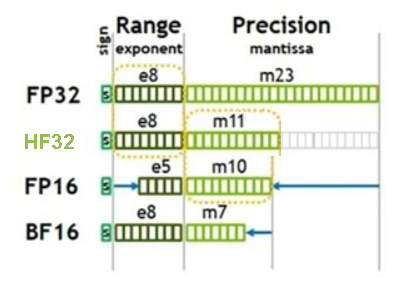
HF32 is a single-precision floating-point type of the AI processor for internal computation of operators. The following figure shows the comparison of HF32 with other common data types. HF32 shares the same value range with FP32, but its mantissa precision (11 bits) is close to that of FP16 (10 bits). Replacing the original FP32 single-precision data type with the HF32 single-precision data type by reducing precision can greatly reduce the space occupied by data and improve performance.
ACL_PRECISION_MODE_V2
Sets the operator precision mode of a network model. If this compilation option is not configured, fp16 is used by default.
Compared with the ACL_PRECISION_MODE option, the ACL_PRECISION_MODE_V2 option is added in the new version, and semantics of the precision mode options are clearer, making them easier to understand.
- fp16 (default):
Forces operators in the original graph to use float16, regardless of whether their original computation precision is float16, bfloat16, or float32.
- origin:
Retain the original precision.
- If the precision of an operator in the original graph is float16, and the implementation of the operator in the AI Core does not support float16 but supports only float32 and bfloat16, the system automatically uses high-precision float32.
- If the precision of an operator in the original graph is float16, and the implementation of the operator in the AI Core does not support float16 but supports only bfloat16, the AI CPU operator of float16 is used. If the AI CPU operator is not supported, an error is reported.
- If the precision of an operator in the original graph is float32, and the implementation of the operator in the AI Core does not support float32 but supports only float16, the AI CPU operator of float32 is used. If the AI CPU operator is not supported, an error is reported.
- cube_fp16in_fp32out:
Selects different processing modes depending on the operator type when an operator supports both the float32 and float16 data types.
- For cube operators, the system processes the computation based on the operator implementation.
- The preferred input data type is float16 and the output data type is float32.
- If the float16 input data and float32 output data types are not supported, set both the input and output data types to float32.
- If the float32 input and output data types are not supported, set both the input and output data types to float16.
- If the float16 input and output data types are not supported, an error is reported.
- Forces vector compute operators in the original graph to use float32, regardless of whether their original computation precision is float16 or bfloat16.
This option takes no effect if the original graph contains operators whose implementation on the AI Core does not support float32, for example, an operator that supports only float16. In this case, the supported float16 is used. If the operator implementation on the AI Core does not support float32 and the blocklist mode is enabled (by setting precision_reduce to false), the float32 AI CPU operator is used. If the AI CPU operator does not support float32 either, an error is reported.
- For cube operators, the system processes the computation based on the operator implementation.
- mixed_float16:
Mixed precision of float16, bfloat16, and float32 is used for neural network processing. For float32 and bfloat16 operators in the original graph, float16 is automatically used for certain float32 and bfloat16 operators based on the built-in tuning policy, which improves system performance and reduces memory usage with minimal accuracy loss.
If this mode is configured, you can view the value of precision_reduce in the built-in tuning policy file ${INSTALL_DIR}/opp/built-in/op_impl/ai_core/tbe/config/xxx/aic-xxx-ops-info-*.json.
- If it is set to true, the operator is on the trustlist and its precision will be reduced from float32 or bfloat16 to float16.
- If it is set to false, the operator is on the blocklist and its precision will not be reduced from float32 or bfloat16 to float16. Such operators will continue to use their original precision (float32 or bfloat16).
- If an operator in the network model does not have precision_reduce configured (that is, it is on the graylist), the mixed-precision handling mechanism for the current operator follows that of the previous operator. That is, if the previous operator supports precision reduction, the current operator also supports it; if the previous operator does not allow precision reduction, the current operator does not either.
- mixed_bfloat16:
Mixed precision of bfloat16 and float32 is used for neural network processing. In this mode, bfloat16 is automatically used for certain float32 operators in the original graph based on the built-in tuning policy, which improves system performance and reduces memory usage with minimal accuracy loss. If an operator supports neither bfloat16 nor float32, the AI CPU operator is used. If the AI CPU operator is also unsupported, an error is reported.
If this mode is configured, you can view the value of precision_reduce in the built-in tuning policy file ${INSTALL_DIR}/opp/built-in/op_impl/ai_core/tbe/config/xxx/aic-xxx-ops-info-*.json.
- If it is set to true, the operator is on trustlist and its precision will be reduced from float32 to bfloat16.
- If it is set to false, the operator is on the blocklist and its precision will not be reduced from float32 to bfloat16.
- If an operator in the network model does not have precision_reduce configured (that is, it is in the graylist), the mixed-precision handling mechanism for the current operator follows that of the previous operator. That is, if the previous operator supports precision reduction, the current operator also supports it; if the previous operator does not allow precision reduction, the current operator does not either.
- mixed_hif8:
Enables automatic mixed precision, indicating that hifloat8 (for details about this data type, click here), float16, bfloat16, and float32 are used together for neural network processing. In this mode, hifloat8 is automatically used for certain float16, bfloat16, and float32 operators in the original graph based on the built-in tuning policy, which improves system performance and reduces memory usage with minimal accuracy loss.
If this mode is configured, you can view the values of precision_reduce in the built-in tuning policy file ${INSTALL_DIR}/opp/built-in/op_impl/ai_core/tbe/config/xxx/aic-xxx-ops-info-*.json.
- If it is set to true, the operator is on the trustlist and its precision will be reduced from float16, bfloat16, or float32 to hifloat8.
- If it is set to false, the operator is on the blocklist and its precision will not be reduced from float16, bfloat16, or float32 to hifloat8. In this case, the operator retains its original precision.
- If an operator in the original graph does not have precision_reduce configured (that is, it is on the graylist), the mixed-precision handling mechanism for the current operator follows that of the previous operator. That is, if the previous operator supports precision reduction, the current operator also supports it; if the previous operator does not allow precision reduction, the current operator does not either.
- cube_hif8:
Forces Cube operators that support both hifloat8 and float16, bfloat16, or float32 in the original graph to use hifloat8.
ACL_OP_DEBUG_OPTION
Currently, this option can only be set to oom, indicating that detection for out-of-bounds global memory access is enabled during operator compilation.
Before compiling an operator, call aclSetCompileopt to set ACL_OP_DEBUG_OPTION to oom and call aclrtCtxSetSysParamOpt (with the scope of context) or aclrtSetSysParamOpt (with the scope of process) to set ACL_OPT_ENABLE_DEBUG_KERNEL to 1 to enable detection for out-of-bounds global memory access. During operator execution, if out-of-bounds access occurs when data is read from or written to the global memory (for example, reading the operator input data or writing the operator output data), the error code "EZ9999" is returned, indicating that the operator has an AI Core error.