The model inference workflow in the dynamic AIPP scenario is similar to that in the scenario described in Developing a Basic Inference App. Both workflows include AscendCL initialization and deinitialization, runtime resource allocation and deallocation, model building, model loading, model execution, and model unloading.
This section focuses on the differences between the two scenarios.
- During model building: You need to set the parameters related to dynamic AIPP.
After model building, the AIPP inputs are added to the generated OM model. During model inference, the AIPP input values are provided.
Assume that the AIPP configuration of input a is dynamic. In the generated .om model, input b is added to describe the AIPP configuration of input a. For details about how to prepare the data structure of input a for model execution, see Preparing Input/Output Data Structure for Model Execution. For details about how to prepare the data structure of input b and set the data of input b, see the following description.
- Before model inference
- Prepare the data structure of the dynamic AIPP inputs.
- Before allocating buffer for a dynamic AIPP input, call aclmdlGetInputIndexByName to obtain the index of the input in the model based on the input name (fixed to ACL_DYNAMIC_AIPP_NAME).
 ACL_DYNAMIC_AIPP_NAME is a macro defined as follows:
#define ACL_DYNAMIC_AIPP_NAME "ascend_dynamic_aipp_data"
- Pass the input index to the aclmdlGetInputSizeByIndex call to obtain the input buffer size.
- Pass the size obtained in 2 to the aclrtMalloc call to allocate buffer.
Do not initialize the buffer manually; otherwise, the service will be unavailable. After the API calls described in 2, the system automatically initializes the buffer.
- Call aclCreateDataBuffer to create data of type aclDataBuffer to describe the buffer address and buffer size of the dynamic AIPP input.
- Call aclmdlCreateDataset to create data of type aclmdlDataset, and call aclmdlAddDatasetBuffer to add data of type aclDataBuffer to data of type aclmdlDataset.
- Before allocating buffer for a dynamic AIPP input, call aclmdlGetInputIndexByName to obtain the index of the input in the model based on the input name (fixed to ACL_DYNAMIC_AIPP_NAME).
- Set dynamic AIPP parameters.
Figure 1 API call sequence
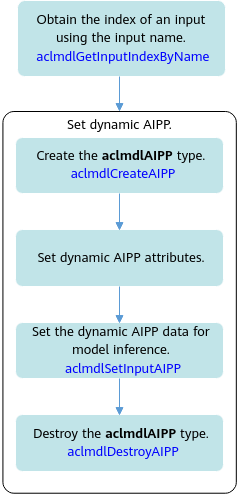
- Call aclmdlGetInputIndexByName to obtain the index of an input using the input name (fixed to ACL_DYNAMIC_AIPP_NAME).
- Set dynamic AIPP parameters.
- Call aclmdlCreateAIPP to create data of type aclmdlAIPP.
- Call the APIs provided in aclmdlAIPP to set dynamic AIPP attributes as required.
- In dynamic AIPP scenarios, aclmdlSetAIPPSrcImageSize must be called to set the source image size.
- Call aclmdlSetInputAIPP to set the dynamic AIPP attributes for model inference.
- Call aclmdlDestroyAIPP to destroy data of type aclmdlAIPP in a timely manner.
- Prepare the data structure of the dynamic AIPP inputs.
AscendCL also supports Digital Vision Pre-Processing (DVPP), which introduces hardware-based media data processing techniques, including resizing, cropping, format conversion, image encoding and decoding, and video encoding and decoding. Compared with AIPP, DVPP offers a wider set of processing operations, but it has particular restrictions on the image input/output and memory allocation.
For details about the DVPP APIs, see Image/Video Data Processing.