The app you develop must contain the code logic for runtime resource allocation. See API Call Sequence to learn about the overall API call sequence before viewing the resource allocation and deallocation workflows in this section.
Runtime resources include the device, context, and stream.
Runtime Resource Allocation
Allocate the device, context, and stream resources in sequence. The context and stream can be created implicitly or explicitly.
- Implicit context and stream creation: applies to simple apps with low complicity of interaction logic. However, in multithreaded programming, each thread uses the default context or stream. The execution sequence of tasks in the default stream depends on the thread scheduling sequence of the operating system.
- (Recommended) Explicit context and stream creation: applies to large apps with complex interaction logic, offering better app readability and maintainability.
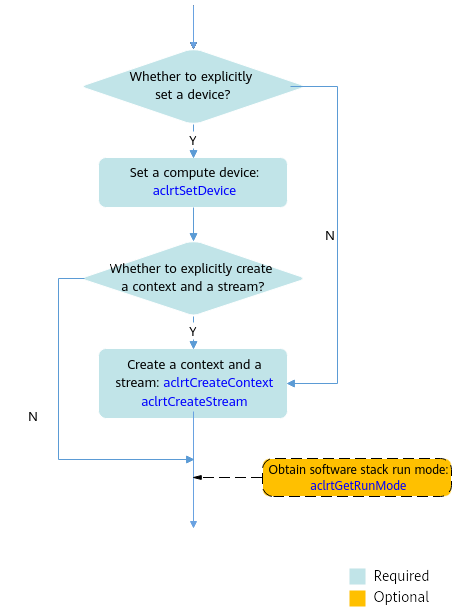
The key APIs are described as follows:
- Allocate the device, context, and stream resources in sequence.
- Call aclrtSetDevice to explicitly set the compute device.
- Call aclrtCreateContext to explicitly create a context and call aclrtCreateStream to explicitly create a stream.
- If the context and stream are not created explicitly, the system uses the default context and stream, which are created implicitly with the aclrtSetDevice call.
To pass the default stream to any API call, pass NULL directly.
- Implicitly set the compute device.
Call aclrtCreateContext to explicitly create a context and call aclrtCreateStream to explicitly create a stream. When a context is explicitly created, the compute device is set by the call to aclrtSetDevice. The device ID is passed to the aclrtCreateContext call.
- Call aclrtSetDevice to explicitly set the compute device.
- (Optional) Call aclrtGetRunMode to obtain the run mode of the software stack and determine the logic of the memory allocation API call based on the run mode.
If the query result is ACL_HOST, host memory needs to be allocated for data transfer.
If the query result is ACL_DEVICE, only device memory needs to be allocated for data transfer.
For details, see Data Transfer.
Runtime Resource Deallocation
Destroy the runtime allocations, including the stream, context, and device in sequence.
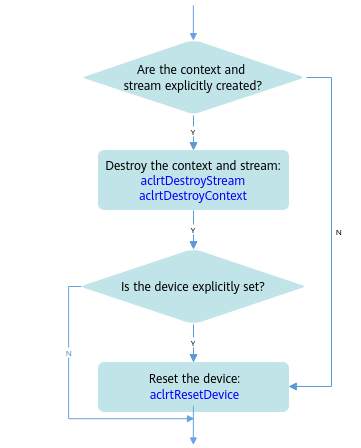
The key APIs are described as follows:
- To destroy an explicitly created stream, call aclrtDestroyStream. To destroy an explicitly created context, call aclrtDestroyContext. To reset an explicitly specified device (by using the call to aclrtSetDevice), call aclrtResetDevice.
- If no context or stream is explicitly created, you only need to call aclrtResetDevice to reset the device.