函数功能
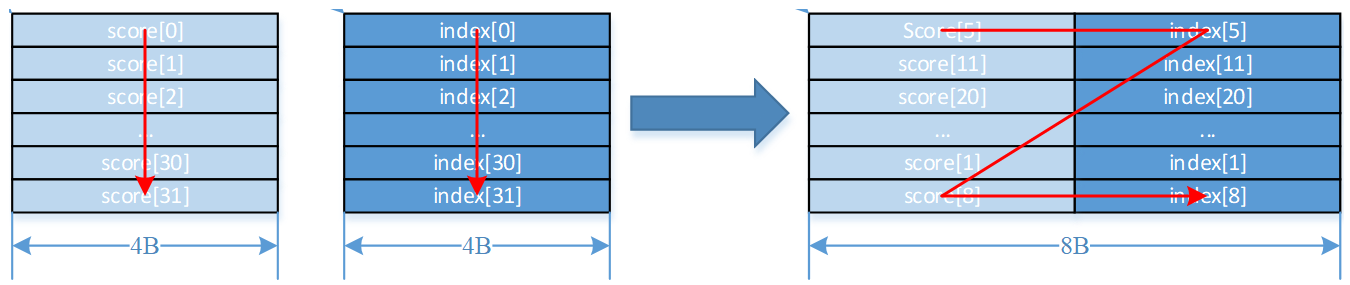
排序函数,按照数值大小进行降序排序。一次迭代可以完成32个数的排序,排序后的数据按照如下排布方式进行保存:
Atlas A2训练系列产品/Atlas 800I A2推理产品采用方式一
Atlas推理系列产品AI Core采用方式二
- 排布方式一:
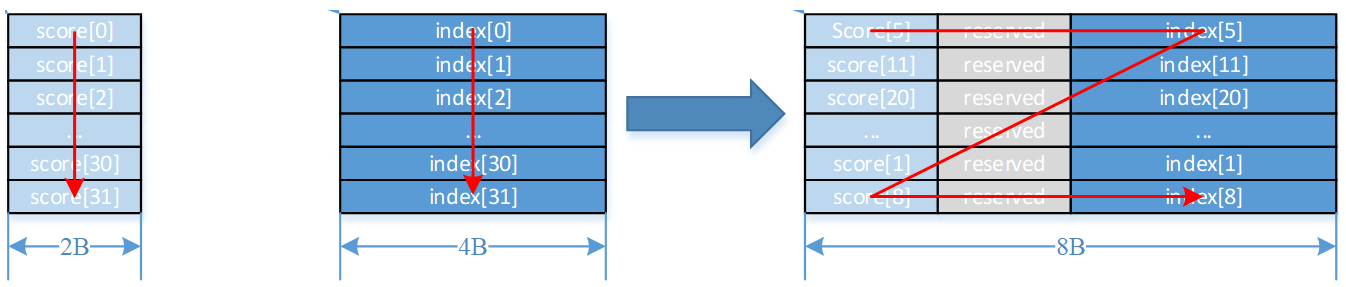
- 排布方式二:Region Proposal排布
输入输出数据均为Region Proposal。每个Region Proposal占用连续8个half/float类型的元素,约定其格式:
[x1, y1, x2, y2, score, label, reserved_0, reserved_1]
对于数据类型half,每一个Region Proposal占16Bytes,Byte[15:12]是无效数据,Byte[11:0]包含6个half类型的元素,其中Byte[11:10]定义为label,Byte[9:8]定义为score,Byte[7:6]定义为y2,Byte[5:4]定义为x2,Byte[3:2]定义为y1,Byte[1:0]定义为x1。
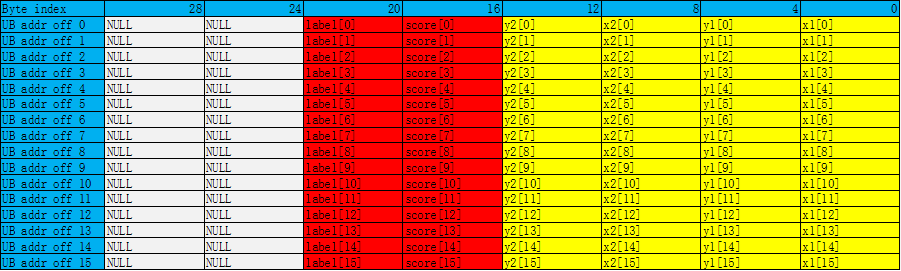
如下图所示,总共包含16个Region Proposals。

对于数据类型float,每一个Region Proposal占32Bytes,Byte[31:24]是无效数据,Byte[23:0]包含6个float类型的元素,其中Byte[23:20]定义为label,Byte[19:16]定义为score,Byte[15:12]定义为y2,Byte[11:8]定义为x2,Byte[7:4]定义为y1,Byte[3:0]定义为x1。
如下图所示,总共包含16个Region Proposals。
函数原型
1 2 |
template <typename T, bool isFullSort> __aicore__ inline void Sort(const LocalTensor<T> &dstLocal, const LocalTensor<T> &concatLocal, const LocalTensor<uint32_t> &indexLocal, LocalTensor<T> &tmpLocal, const int32_t repeatTimes) |
参数说明
|
接口 |
功能 |
|---|---|
|
T |
操作数的数据类型。 |
|
isFullSort |
是否开启全排序模式。全排序模式指将全部输入降序排序,非全排序模式下,排序方式请参考表2中的repeatTimes说明。 |
|
参数名称 |
输入/输出 |
含义 |
|---|---|---|
|
dstLocal |
输出 |
目的操作数。 类型为LocalTensor,支持的TPosition为VECIN/VECCALC/VECOUT。 Atlas A2训练系列产品/Atlas 800I A2推理产品,支持的数据类型为:half/float Atlas推理系列产品AI Core,支持的数据类型为:half/float |
|
concatLocal |
输入 |
源操作数。 类型为LocalTensor,支持的TPosition为VECIN/VECCALC/VECOUT。 此源操作数的数据类型需要与目的操作数保持一致。 Atlas A2训练系列产品/Atlas 800I A2推理产品,支持的数据类型为:half/float Atlas推理系列产品AI Core,支持的数据类型为:half/float |
|
indexLocal |
输入 |
源操作数。 类型为LocalTensor,支持的TPosition为VECIN/VECCALC/VECOUT。 此源操作数固定为uint32_t数据类型。 |
|
tmpLocal |
输入 |
临时空间。接口内部复杂计算时用于存储中间变量,由开发者提供。数据类型与源操作数保持一致。 类型为LocalTensor,支持的TPosition为VECIN/VECCALC/VECOUT。 Atlas A2训练系列产品/Atlas 800I A2推理产品,支持的数据类型为:half/float Atlas推理系列产品AI Core,支持的数据类型为:half/float |
|
repeatTimes |
输入 |
重复迭代次数,int32_t类型。
|
返回值
无
支持的型号
Atlas A2训练系列产品/Atlas 800I A2推理产品
Atlas推理系列产品AI Core
约束说明
- 当存在score[i]与score[j]相同时,如果i>j,则score[j]将首先被选出来,排在前面,即index的顺序与输入顺序一致。
- 非全排序模式下,每次迭代内的数据会进行排序,不同迭代间的数据不会进行排序。
- 操作数地址偏移对齐要求请参见通用约束。
调用示例
- 处理128个half类型数据。
Atlas A2训练系列产品/Atlas 800I A2推理产品
#include "kernel_operator.h"

template <typename T>
class FullSort
{
public:
    __aicore__ inline FullSort() {}
    __aicore__ inline void Init(__gm__ uint8_t *srcValueGm, __gm__ uint8_t *srcIndexGm, __gm__ uint8_t *dstValueGm, __gm__ uint8_t *dstIndexGm)
    {
        concatRepeatTimes = elementCount / 16;
        inBufferSize = elementCount * sizeof(uint32_t);
        outBufferSize = elementCount * sizeof(uint32_t);
        calcBufferSize = elementCount * 8;
        tmpBufferSize = elementCount * 8;
        sortedLocalSize = elementCount * 4;
        sortRepeatTimes = elementCount / 32;
        extractRepeatTimes = elementCount / 32;
        sortTmpLocalSize = elementCount * 4;
        valueGlobal.SetGlobalBuffer((__gm__ T *)srcValueGm);
        indexGlobal.SetGlobalBuffer((__gm__ uint32_t *)srcIndexGm);
        m_dstValueGlobal.SetGlobalBuffer((__gm__ T *)dstValueGm);
        dstIndexGlobal.SetGlobalBuffer((__gm__ uint32_t *)dstIndexGm);
        m_pipe.InitBuffer(queIn, 2, inBufferSize);
        m_pipe.InitBuffer(queOut, 2, outBufferSize);
        m_pipe.InitBuffer(queCalc, 1, calcBufferSize * sizeof(T));
        m_pipe.InitBuffer(queTmp, 2, tmpBufferSize * sizeof(T));
    }
    __aicore__ inline void Process()
    {
        CopyIn();
        Compute();
        CopyOut();
    }

private:
    __aicore__ inline void CopyIn()
    {
        AscendC::LocalTensor<T> valueLocal = queIn.AllocTensor<T>();
        AscendC::DataCopy(valueLocal, valueGlobal, elementCount);
        queIn.EnQue(valueLocal);
        AscendC::LocalTensor<uint32_t> indexLocal = queIn.AllocTensor<uint32_t>();
        AscendC::DataCopy(indexLocal, indexGlobal, elementCount);
        queIn.EnQue(indexLocal);
    }
    __aicore__ inline void Compute()
    {
        AscendC::LocalTensor<T> valueLocal = queIn.DeQue<T>();
        AscendC::LocalTensor<uint32_t> indexLocal = queIn.DeQue<uint32_t>();
        AscendC::LocalTensor<T> sortedLocal = queCalc.AllocTensor<T>();
        AscendC::LocalTensor<T> concatTmpLocal = queTmp.AllocTensor<T>();
        AscendC::LocalTensor<T> sortTmpLocal = queTmp.AllocTensor<T>();
        AscendC::LocalTensor<T> dstValueLocal = queOut.AllocTensor<T>();
        AscendC::LocalTensor<uint32_t> dstIndexLocal = queOut.AllocTensor<uint32_t>();
        AscendC::LocalTensor<T> concatLocal;

        AscendC::Concat(concatLocal, valueLocal, concatTmpLocal, concatRepeatTimes);
        AscendC::Sort<T, true>(sortedLocal, concatLocal, indexLocal, sortTmpLocal, sortRepeatTimes);
        AscendC::Extract(dstValueLocal, dstIndexLocal, sortedLocal, extractRepeatTimes);

        queTmp.FreeTensor(concatTmpLocal);
        queTmp.FreeTensor(sortTmpLocal);
        queIn.FreeTensor(valueLocal);
        queIn.FreeTensor(indexLocal);
        queCalc.FreeTensor(sortedLocal);
        queOut.EnQue(dstValueLocal);
        queOut.EnQue(dstIndexLocal);
    }
    __aicore__ inline void CopyOut()
    {
        AscendC::LocalTensor<T> dstValueLocal = queOut.DeQue<T>();
        AscendC::LocalTensor<uint32_t> dstIndexLocal = queOut.DeQue<uint32_t>();
        AscendC::DataCopy(m_dstValueGlobal, dstValueLocal, elementCount);
        AscendC::DataCopy(dstIndexGlobal, dstIndexLocal, elementCount);
        queOut.FreeTensor(dstValueLocal);
        queOut.FreeTensor(dstIndexLocal);
    }

private:
    AscendC::TPipe m_pipe;
    AscendC::TQue<AscendC::QuePosition::VECIN, 2> queIn;
    AscendC::TQue<AscendC::QuePosition::VECOUT, 2> queOut;
    AscendC::TQue<AscendC::QuePosition::VECIN, 2> queTmp;
    AscendC::TQue<AscendC::QuePosition::VECIN, 1> queCalc;
    AscendC::GlobalTensor<T> valueGlobal;
    AscendC::GlobalTensor<uint32_t> indexGlobal;
    AscendC::GlobalTensor<T> m_dstValueGlobal;
    AscendC::GlobalTensor<uint32_t> dstIndexGlobal;
    uint32_t elementCount = 128;
    uint32_t concatRepeatTimes;
    uint32_t inBufferSize;
    uint32_t outBufferSize;
    uint32_t calcBufferSize;
    uint32_t tmpBufferSize;
    uint32_t sortedLocalSize;
    uint32_t sortTmpLocalSize;
    uint32_t sortRepeatTimes;
    uint32_t extractRepeatTimes;
};

extern "C" __global__ __aicore__ void sort_operator(__gm__ uint8_t *src0Gm, __gm__ uint8_t *src1Gm, __gm__ uint8_t *dst0Gm, __gm__ uint8_t *dst1Gm)
{
    FullSort<half> op;
    op.Init(src0Gm, src1Gm, dst0Gm, dst1Gm);
    op.Process();
}
示例结果 输入数据(srcValueGm): 128个float类型数据 [31 30 29 ... 2 1 0 63 62 61 ... 34 33 32 95 94 93 ... 66 65 64 127 126 125 ... 98 97 96] 输入数据(srcIndexGm): [31 30 29 ... 2 1 0 63 62 61 ... 34 33 32 95 94 93 ... 66 65 64 127 126 125 ... 98 97 96] 输出数据(dstValueGm): [127 126 125 ... 2 1 0] 输出数据(dstIndexGm): [127 126 125 ... 2 1 0]
- 处理64个half类型数据。
Atlas推理系列产品AI Core
#include "kernel_operator.h"

template <typename T>
class FullSort
{
public:
    __aicore__ inline FullSort() {}
    __aicore__ inline void Init(__gm__ uint8_t *srcValueGm, __gm__ uint8_t *srcIndexGm, __gm__ uint8_t *dstValueGm, __gm__ uint8_t *dstIndexGm)
    {
        concatRepeatTimes = elementCount / 16;
        inBufferSize = elementCount * sizeof(uint32_t);
        outBufferSize = elementCount * sizeof(uint32_t);
        calcBufferSize = elementCount * 8;
        tmpBufferSize = elementCount * 8;
        sortedLocalSize = elementCount * 8 * sizeof(T);
        sortRepeatTimes = elementCount / 16;
        extractRepeatTimes = elementCount / 16;
        sortTmpLocalSize = elementCount * 8 * sizeof(T);
        m_valueGlobal.SetGlobalBuffer((__gm__ T *)srcValueGm);
        indexGlobal.SetGlobalBuffer((__gm__ uint32_t *)srcIndexGm);
        m_dstValueGlobal.SetGlobalBuffer((__gm__ T *)dstValueGm);
        dstIndexGlobal.SetGlobalBuffer((__gm__ uint32_t *)dstIndexGm);
        m_pipe.InitBuffer(queIn, 2, inBufferSize);
        m_pipe.InitBuffer(queOut, 2, outBufferSize);
        m_pipe.InitBuffer(queCalc, 1, calcBufferSize * sizeof(T));
        m_pipe.InitBuffer(queTmp, 2, tmpBufferSize * sizeof(T));
    }
    __aicore__ inline void Process()
    {
        CopyIn();
        Compute();
        CopyOut();
    }

private:
    __aicore__ inline void CopyIn()
    {
        AscendC::LocalTensor<T> valueLocal = queIn.AllocTensor<T>();
        AscendC::DataCopy(valueLocal, m_valueGlobal, elementCount);
        queIn.EnQue(valueLocal);

        AscendC::LocalTensor<uint32_t> indexLocal = queIn.AllocTensor<uint32_t>();
        AscendC::DataCopy(indexLocal, indexGlobal, elementCount);
        queIn.EnQue(indexLocal);
    }
    __aicore__ inline void Compute()
    {
        AscendC::LocalTensor<T> valueLocal = queIn.DeQue<T>();
        AscendC::LocalTensor<uint32_t> indexLocal = queIn.DeQue<uint32_t>();
        AscendC::LocalTensor<T> sortedLocal = queCalc.AllocTensor<T>();
        AscendC::LocalTensor<T> concatTmpLocal = queTmp.AllocTensor<T>();
        AscendC::LocalTensor<T> sortTmpLocal = queTmp.AllocTensor<T>();
        AscendC::LocalTensor<T> dstValueLocal = queOut.AllocTensor<T>();
        AscendC::LocalTensor<uint32_t> dstIndexLocal = queOut.AllocTensor<uint32_t>();
        AscendC::LocalTensor<T> concatLocal;

        AscendC::Concat(concatLocal, valueLocal, concatTmpLocal, concatRepeatTimes);
        AscendC::Sort<T, true>(sortedLocal, concatLocal, indexLocal, sortTmpLocal, sortRepeatTimes);
        AscendC::Extract(dstValueLocal, dstIndexLocal, sortedLocal, extractRepeatTimes);

        queTmp.FreeTensor(concatTmpLocal);
        queTmp.FreeTensor(sortTmpLocal);
        queIn.FreeTensor(valueLocal);
        queIn.FreeTensor(indexLocal);
        queCalc.FreeTensor(sortedLocal);
        queOut.EnQue(dstValueLocal);
        queOut.EnQue(dstIndexLocal);
    }
    __aicore__ inline void CopyOut()
    {
        AscendC::LocalTensor<T> dstValueLocal = queOut.DeQue<T>();
        AscendC::LocalTensor<uint32_t> dstIndexLocal = queOut.DeQue<uint32_t>();
        AscendC::DataCopy(m_dstValueGlobal, dstValueLocal, elementCount);
        AscendC::DataCopy(dstIndexGlobal, dstIndexLocal, elementCount);
        queOut.FreeTensor(dstValueLocal);
        queOut.FreeTensor(dstIndexLocal);
    }

private:
    AscendC::TPipe m_pipe;
    AscendC::TQue<AscendC::QuePosition::VECIN, 2> queIn;
    AscendC::TQue<AscendC::QuePosition::VECOUT, 2> queOut;
    AscendC::TQue<AscendC::QuePosition::VECIN, 2> queTmp;
    AscendC::TQue<AscendC::QuePosition::VECIN, 1> queCalc;
    AscendC::GlobalTensor<T> m_valueGlobal;
    AscendC::GlobalTensor<uint32_t> indexGlobal;
    AscendC::GlobalTensor<T> m_dstValueGlobal;
    AscendC::GlobalTensor<uint32_t> dstIndexGlobal;
    uint32_t elementCount = 64;
    uint32_t concatRepeatTimes;
    uint32_t inBufferSize;
    uint32_t outBufferSize;
    uint32_t calcBufferSize;
    uint32_t tmpBufferSize;
    uint32_t sortedLocalSize;
    uint32_t sortTmpLocalSize;
    uint32_t sortRepeatTimes;
    uint32_t extractRepeatTimes;
};

extern "C" __global__ __aicore__ void sort_operator(__gm__ uint8_t *src0Gm, __gm__ uint8_t *src1Gm, __gm__ uint8_t *dst0Gm, __gm__ uint8_t *dst1Gm)
{
    FullSort<half> op;
    op.Init(src0Gm, src1Gm, dst0Gm, dst1Gm);
    op.Process();
}
示例结果 输入数据(srcValueGm): 128个float类型数据 [15 14 13 ... 2 1 0 31 30 29 ... 18 17 16 47 46 45 ... 34 33 32 63 62 61 ... 50 49 48] 输入数据(srcIndexGm): [15 14 13 ... 2 1 0 31 30 29 ... 18 17 16 47 46 45 ... 34 33 32 63 62 61 ... 50 49 48] 输出数据(dstValueGm): [63 62 61 ... 2 1 0] 输出数据(dstIndexGm): [63 62 61 ... 2 1 0]