功能说明
根据最后一轴的方向对各元素求平均值。
如果输入是向量,则在向量中对各元素相加求平均;如果输入是矩阵,则沿最后一个维度对元素求平均。本接口最多支持输入为二维数据,不支持更高维度的输入。
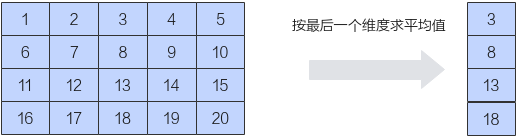
如下图所示,对shape为(4, 5)的二维矩阵进行求平均操作,输出结果为[3, 8, 13, 18]。
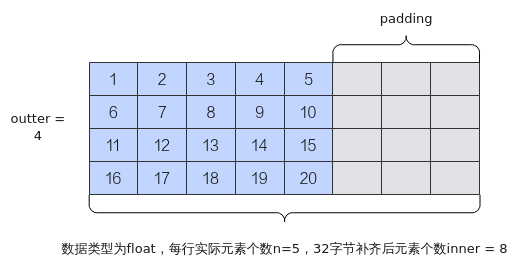
在了解接口具体功能之前,需要了解一些必备概念:数据的行数称之为外轴长度(outter),每行实际的元素个数称之为内轴的实际元素个数(n),内轴实际元素个数n向上32字节对齐后的元素个数称之为补齐后的内轴元素个数(inner)。本接口要求输入的内轴长度满足32字节对齐,所以当n占据的字节长度不是32字节的整数倍时,需要开发者将其向上补齐到32字节的整数倍。如下样例中,元素类型为float,每行的实际元素个数n为5,占据字节长度为20字节,不是32字节的整数倍,向上补齐后得到32字节,对应的元素个数为8。图中的padding代表补齐操作。n和inner的关系如下:inner = (n *sizeof(T) + 32 - 1) / 32 * 32 / sizeof(T)。
函数原型
- 通过sharedTmpBuffer入参传入临时空间
template <typename T, typename accType = T, bool isReuseSource = false>
__aicore__ inline void Mean(const LocalTensor<T>& dstTensor, const LocalTensor<T>& srcTensor, const LotcalTensor<uint8_t>& sharedTmpBuffer, const MeanParams& meanParam)
- 接口框架申请临时空间
template <typename T, typename accType = T, bool isReuseSource = false>
__aicore__ inline void Mean(const LocalTensor<T>& dstTensor, const LocalTensor<T>& srcTensor, const MeanParams& meanParam)
由于该接口的内部实现中涉及复杂的数学计算,需要额外的临时空间来存储计算过程中的中间变量。临时空间支持开发者通过sharedTmpBuffer入参传入和接口框架申请两种方式。
- 通过sharedTmpBuffer入参传入,使用该tensor作为临时空间进行处理,接口框架不再申请。该方式开发者可以自行管理sharedTmpBuffer内存空间,并在接口调用完成后,复用该部分内存,内存不会反复申请释放,灵活性较高,内存利用率也较高。
- 接口框架申请临时空间,开发者无需申请,但是需要预留临时空间的大小。
通过sharedTmpBuffer传入的情况,开发者需要为tensor申请空间;接口框架申请的方式,开发者需要预留临时空间。临时空间大小BufferSize的获取方式如下:通过GetMeanMaxMinTmpSize中提供的接口获取需要预留空间范围的大小。
参数说明
参数名 |
描述 |
|---|---|
T |
操作数的数据类型。 |
accType |
实际参与计算的数据类型,设置的accType精度高于输入T的情况下,在计算之前会将输入转换为accType,使用accType类型计算,计算完成后再转换为原来的数据类型。设置accType值升精度可以防止数据类型溢出。T为half时,您可以将accType设置为float,表示为输入half类型升精度至float进行计算。不支持accType精度低于输入T的情况。 |
isReuseSource |
是否允许修改源操作数。该参数预留,传入默认值false即可。 |
参数名 |
输入/输出 |
描述 |
|---|---|---|
dstTensor |
输出 |
目的操作数。 类型为LocalTensor,支持的TPosition为VECIN/VECCALC/VECOUT。 Atlas A2训练系列产品/Atlas 800I A2推理产品,支持的数据类型为:half/float Atlas推理系列产品AI Core,支持的数据类型为:half/float 输出值需要outter * sizeof(T)大小的空间进行保存。开发者要根据该大小和框架的对齐要求来为dstTensor分配实际内存空间。 |
srcTensor |
输入 |
源操作数。 类型为LocalTensor,支持的TPosition为VECIN/VECCALC/VECOUT。 源操作数的数据类型需要与目的操作数保持一致。 Atlas A2训练系列产品/Atlas 800I A2推理产品,支持的数据类型为:half/float Atlas推理系列产品AI Core,支持的数据类型为:half/float 输入数据shape为outter * inner。开发者需要为其开辟大小为outter * inner * sizeof(T)的空间。 |
sharedTmpBuffer |
输入 |
临时缓存。 类型为LocalTensor,支持的TPosition为VECIN/VECCALC/VECOUT。 用于Mean内部复杂计算时存储中间变量,由开发者提供。 临时空间大小BufferSize的获取方式请参考GetMeanMaxMinTmpSize。 Atlas A2训练系列产品/Atlas 800I A2推理产品,支持的数据类型为:uint8_t Atlas推理系列产品AI Core, 支持的数据类型为: uint8_t |
MeanParams |
输入 |
srcTensor的shape信息。MeanParams类型,具体定义如下: struct MeanParams{
uint32_t outter = 1; // 表示输入数据的外轴长度
uint32_t inner; // 表示输入数据内轴实际元素个数32字节补齐后的元素个数,inner*sizeof(T)必须是32字节的整数倍
uint32_t n; // 表示输入数据内轴的实际元素个数
};
|
返回值
无
支持的型号
Atlas A2训练系列产品/Atlas 800I A2推理产品
Atlas推理系列产品AI Core
约束说明
- 操作数地址偏移对齐要求请参见通用约束。
- 不支持源操作数与目的操作数地址重叠,不支持sharedTmpBuffer与源操作数和目的操作数地址重叠。
- 当前仅支持ND格式的输入,不支持其他格式。
- 对于mean, 采用的方式为先求和再做除法,其求和时内部使用的底层相加方式与Sum、ReducceSum以及WholeReducceSum的内部的相加方式一致,采用二叉树方式,两两相加,可参考Sum。
调用示例
- kernel侧调用示例
#include "kernel_operator.h"
using namespace AscendC;
template <typename T, typename accType> class KernelMean {
public:
    __aicore__ inline KernelMean() {}
    __aicore__ inline void Init(__gm__ uint8_t* srcGm, __gm__ uint8_t* dstGm, uint32_t outter, uint32_t inner, uint32_t n, uint32_t Size)
    {
        meanParams.outter = outter;
        meanParams.inner = inner;
        meanParams.n = n;
        tmpSize = Size;
        srcGlobal.SetGlobalBuffer((__gm__ T*)srcGm);
        dstGlobal.SetGlobalBuffer((__gm__ T*)dstGm);
        pipe.InitBuffer(inQueueX, 1, meanParams.outter * meanParams.inner * sizeof(T));
        pipe.InitBuffer(outQueueY, 1, (meanParams.outter * sizeof(T) + ONE_BLK_SIZE - 1) / ONE_BLK_SIZE * ONE_BLK_SIZE);
    }
    __aicore__ inline void Process()
    {
        CopyIn();
        Compute();
        CopyOut();
    }
private:
    __aicore__ inline void CopyIn()
    {
        LocalTensor<T> srcLocal = inQueueX.AllocTensor<T>();
        DataCopy(srcLocal, srcGlobal, meanParams.outter * meanParams.inner);
        inQueueX.EnQue(srcLocal);
    }
    __aicore__ inline void Compute()
    {
        LocalTensor<T> srcLocal = inQueueX.DeQue<T>();
        LocalTensor<T> dstLocal = outQueueY.AllocTensor<T>();
        if (tmpSize != 0) { // 使用temTensor
            pipe.InitBuffer(tmplocalBuf, tmpSize);
            LocalTensor<uint8_t> tmplocalTensor = tmplocalBuf.Get<uint8_t>();
            Mean<T, accType>(dstLocal, srcLocal, tmplocalTensor, meanParams);
        } else {
            Mean<T, accType>(dstLocal, srcLocal, meanParams);
        }
        outQueueY.EnQue<T>(dstLocal);
    }
    __aicore__ inline void CopyOut()
    {
        LocalTensor<T> dstLocal = outQueueY.DeQue<T>();
        DataCopy(dstGlobal, dstLocal, (meanParams.outter * sizeof(T) + ONE_BLK_SIZE -1) / ONE_BLK_SIZE * ONE_BLK_SIZE / sizeof(T));
        outQueueY.FreeTensor(dstLocal);
    }
private:
    GlobalTensor<T> srcGlobal;
    GlobalTensor<T> dstGlobal;
    TPipe pipe;
    TQue<QuePosition::VECIN, 1> inQueueX;
    TQue<QuePosition::VECOUT, 1> outQueueY;
    TBuf<TPosition::VECCALC> tmplocalBuf;
    MeanParams meanParams;
    uint32_t tmpSize;
};
extern "C" __global__ __aicore__ void mean_custom(GM_ADDR x, GM_ADDR y, GM_ADDR workspace, GM_ADDR tiling) {
    GET_TILING_DATA(tiling_data, tiling);
    // TODO: user kernel impl
    if (TILING_KEY_IS(1)) {
        KernelMean<half, half> op;
        op.Init(x, y, tiling_data.outter, tiling_data.inner, tiling_data.n, tiling_data.tmpSize);
        op.Process();
    }else if(TILING_KEY_IS(2)) {
        KernelMean<float, float> op;
        op.Init(x, y, tiling_data.outter, tiling_data.inner, tiling_data.n, tiling_data.tmpSize);
        op.Process();
    }else if(TILING_KEY_IS(3)) {
        KernelMean<half, float> op;
        op.Init(x, y, tiling_data.outter, tiling_data.inner, tiling_data.n, tiling_data.tmpSize);
        op.Process();
    }
}
- host侧tiling定义如下:
#include "register/tilingdata_base.h"
namespace optiling {
BEGIN_TILING_DATA_DEF(MeanCustomTilingData)
  TILING_DATA_FIELD_DEF(uint32_t, outter);
  TILING_DATA_FIELD_DEF(uint32_t, inner);
  TILING_DATA_FIELD_DEF(uint32_t, n);
  TILING_DATA_FIELD_DEF(uint32_t, tmpSize);
END_TILING_DATA_DEF;
REGISTER_TILING_DATA_CLASS(MeanCustom, MeanCustomTilingData)
}
- host侧tiling实现如下:
#include "mean_custom_tiling.h"
#include "register/op_def_registry.h"
#include "tiling/tiling_api.h"
namespace optiling {
static ge::graphStatus TilingFunc(gert::TilingContext* context)
{
    MeanCustomTilingData tiling;
    const gert::StorageShape *src_shape = context->GetInputShape(0); // src_shape给两维
    uint32_t outter = src_shape->GetStorageShape().GetDim(0);
    uint32_t inner = src_shape->GetStorageShape().GetDim(1);

    const gert::RuntimeAttrs *meanattrs = context->GetAttrs();
    const uint32_t n = *(meanattrs->GetAttrPointer<uint32_t>(0));
    const uint32_t iscast = *(meanattrs->GetAttrPointer<uint32_t>(1)); // iscast为1表示accType升精度
    const uint32_t sizeflag = *(meanattrs->GetAttrPointer<uint32_t>(2)); // sizeflag为0表示框架申请tmpbuffer,为1表示通过sharedTmpBuffer入参传入临时空间
    auto dt = context->GetInputTensor(0)->GetDataType();
    uint32_t typeSize = 0;
    if (iscast == 1) {
        typeSize = 2;
        context->SetTilingKey(3);
    } else if(dt == ge::DT_FLOAT16) {
        typeSize = 2;
        context->SetTilingKey(1);
    } else if (dt == ge::DT_FLOAT) {
        typeSize = 4;
        context->SetTilingKey(2);
    }
    uint32_t maxValue = 0;
    uint32_t minValue = 0;
    if (iscast == 1) {
        AscendC::GetMeanMaxMinTmpSize(n, typeSize, 4, false, maxValue, minValue);
    } else {
        AscendC::GetMeanMaxMinTmpSize(n, typeSize, typeSize, false, maxValue, minValue);
    }
    if (sizeflag == 0) {
        tiling.set_tmpSize(0);
    } else {
        tiling.set_tmpSize(minValue);
    }
    tiling.set_outter(outter);
    tiling.set_inner(inner);
    tiling.set_n(n);
    context->SetBlockDim(1);
    tiling.SaveToBuffer(context->GetRawTilingData()->GetData(), context->GetRawTilingData()->GetCapacity());
    context->GetRawTilingData()->SetDataSize(tiling.GetDataSize());
    size_t *currentWorkspace = context->GetWorkspaceSizes(1);
    currentWorkspace[0] = 0;
    return ge::GRAPH_SUCCESS;
}
}
结果示例如下:
输入数据(srcLocal): [[1 2 3 0 0 0 0 0 0 0 0 0 0 0 0 0],
                     [4 5 6 0 0 0 0 0 0 0 0 0 0 0 0 0]]
输出数据(dstLocal): [2 5 0 0 0 0 0 0 0 0 0 0 0 0 0 0]