功能说明
按元素做伪量化计算,比如将int8_t数据类型伪量化为half数据类型,计算公式如下:
- per channel场景(按通道量化)
实现原理
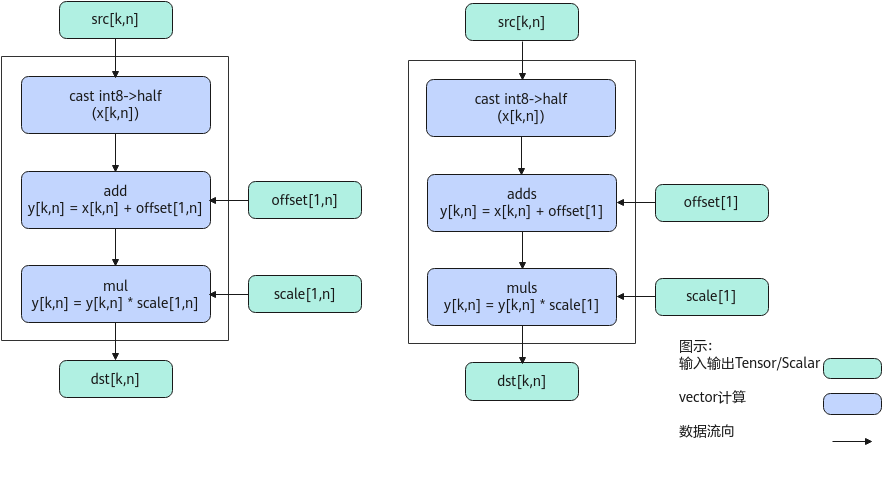
如上图所示,为AscendAntiQuantd典型场景算法框图,计算过程分为如下几步,均在Vector上进行:
- 精度转换:将输入src转换为half类型;
- 计算offset:当offset为向量时做Add计算,当offset为scalar时做Adds计算;
- 计算scale:当scale为向量时做Mul计算,当scale为scalar时做Muls计算。
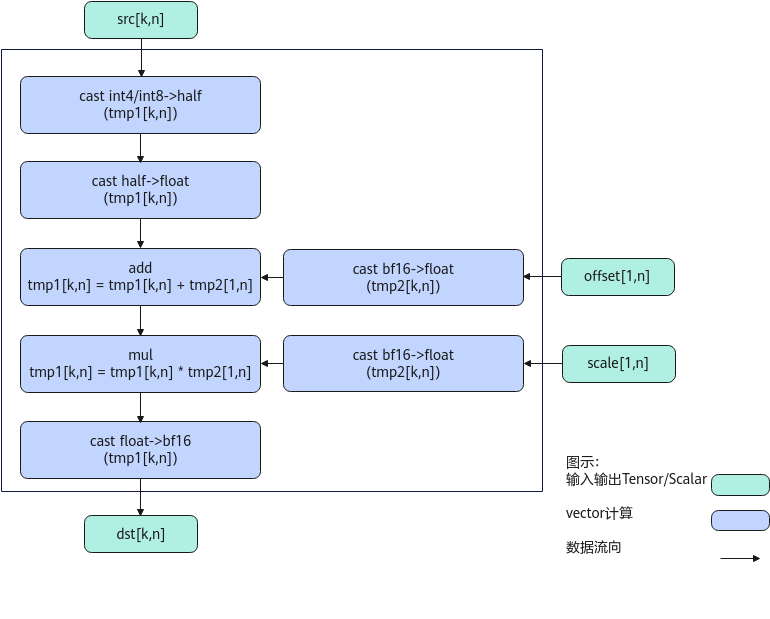
在Atlas A2训练系列产品/Atlas 800I A2推理产品上,当输出为bfloat16时,计算过程分为如下几步:
- src精度转换:将输入的src转换为half类型,再转换为float类型,存放到tmp1;
- offset精度转换:当输入的offset为向量时转换为float类型,存放到tmp2,为scalar时做ToFloat转换为float类型;
- 计算offset:当输入的offset为向量时与tmp2做Add计算,为scalar时做Adds计算;
- scale精度转换:当输入的scale为向量时转换为float类型,存放到tmp2,为scalar时做ToFloat转换为float类型;
- 计算scale:当输入的scale为向量时用tmp2做Mul计算,为scalar时做Muls计算;
- dst精度转换:将tmp1转换为bf16类型。
函数原型
- 通过sharedTmpBuffer入参传入临时空间
- per channel场景(按通道量化)
template <typename InputDataType, typename OutputDataType, bool isTranspose>
__aicore__ inline void AscendAntiQuant(const LocalTensor<OutputDataType> &dst, const LocalTensor<InputDataType> &src, const LocalTensor<OutputDataType> &offset, const LocalTensor<OutputDataType> &scale, const LocalTensor<uint8_t> &sharedTmpBuffer, const uint32_t K)
- per tensor场景 (按张量量化)
template <typename InputDataType, typename OutputDataType, bool isTranspose>
__aicore__ inline void AscendAntiQuant(const LocalTensor<OutputDataType> &dst, const LocalTensor<InputDataType> &src, const OutputDataType offset, const OutputDataType scale, const LocalTensor<uint8_t> &sharedTmpBuffer, const uint32_t K)
- per channel场景(按通道量化)
- 接口框架申请临时空间
- per channel场景
template <typename InputDataType, typename OutputDataType, bool isTranspose>
__aicore__ inline void AscendAntiQuant(const LocalTensor<OutputDataType> &dst, const LocalTensor<InputDataType> &src, const LocalTensor<OutputDataType> &offset, const LocalTensor<OutputDataType> &scale, const uint32_t K)
- per tensor场景
template <typename InputDataType, typename OutputDataType, bool isTranspose>
__aicore__ inline void AscendAntiQuant(const LocalTensor<OutputDataType> &dst, const LocalTensor<InputDataType> &src, const OutputDataType offset, const OutputDataType scale, const uint32_t K)
- per channel场景
由于该接口的内部实现中涉及复杂的数学计算,需要额外的临时空间来存储计算过程中的中间变量。临时空间支持接口框架申请和开发者通过sharedTmpBuffer入参传入两种方式。
- 接口框架申请临时空间,开发者无需申请,但是需要预留临时空间的大小。
- 通过sharedTmpBuffer入参传入,使用该tensor作为临时空间进行处理,接口框架不再申请。该方式开发者可以自行管理sharedTmpBuffer内存空间,并在接口调用完成后,复用该部分内存,内存不会反复申请释放,灵活性较高,内存利用率也较高。
接口框架申请的方式,开发者需要预留临时空间;通过sharedTmpBuffer传入的情况,开发者需要为sharedTmpBuffer申请空间。临时空间大小BufferSize的获取方式如下:通过GetAscendAntiQuantMaxMinTmpSize中提供的接口获取需要预留空间的范围大小。
参数说明
|
参数名 |
描述 |
|---|---|
|
InputDataType |
输入的数据类型。 |
|
OutputDataType |
输出的数据类型。 |
|
isTranspose |
是否使能输入数据转置。 |
|
参数名 |
输入/输出 |
描述 |
|---|---|---|
|
dst |
输出 |
目的操作数。 类型为LocalTensor,支持的TPosition为VECIN/VECCALC/VECOUT。 Atlas A2训练系列产品/Atlas 800I A2推理产品,支持的数据类型为:half/bfloat16 Atlas推理系列产品AI Core,支持的数据类型为:half |
|
src |
输入 |
源操作数。 类型为LocalTensor,支持的TPosition为VECIN/VECCALC/VECOUT。 Atlas A2训练系列产品/Atlas 800I A2推理产品,支持的数据类型为:int8_t/int4b_t Atlas推理系列产品AI Core,支持的数据类型为:int8_t |
|
offset |
输入 |
输入数据反量化时的偏移量。per channel场景下,shape与src保持一致。 类型为LocalTensor,支持的TPosition为VECIN/VECCALC/VECOUT。 Atlas A2训练系列产品/Atlas 800I A2推理产品,支持的数据类型为:half/bfloat16 Atlas推理系列产品AI Core,支持的数据类型为:half |
|
scale |
输入 |
输入数据反量化时的缩放因子。per channel场景下,shape与src保持一致 类型为LocalTensor,支持的TPosition为VECIN/VECCALC/VECOUT。 Atlas A2训练系列产品/Atlas 800I A2推理产品,支持的数据类型为:half/bfloat16 Atlas推理系列产品AI Core,支持的数据类型为:half |
|
sharedTmpBuffer |
输入 |
临时缓存。 类型为LocalTensor,支持的TPosition为VECIN/VECCALC/VECOUT。 临时空间大小BufferSize的获取方式请参考GetAscendAntiQuantMaxMinTmpSize。 |
|
K |
输入 |
isTranspose为true时,src的shape为[N,K];isTranspose为false时,src的shape为[K,N]。 参数K对应其中的K值。 |
返回值
无
支持的型号
Atlas A2训练系列产品/Atlas 800I A2推理产品
Atlas推理系列产品AI Core
约束说明
- 不支持源操作数与目的操作数地址重叠。
- 操作数地址偏移对齐要求请参见通用约束。
- 输入输出操作数参与计算的数据长度要求32B对齐。
- 输入带转置场景,K需要32B对齐。
- 调用接口前,确保输入数据的size正确,offset和scale的size和shape正确。
调用示例
namespace AscendC {
template <typename InputDataType, typename OutputDataType>
class AntiQuantTest {
public:
    __aicore__ inline AntiQuantTest() {}
    __aicore__ inline void Init(GM_ADDR dstGm, GM_ADDR srcGm, GM_ADDR offsetGm, GM_ADDR scaleGm,
        uint32_t elementCountOfInput, uint32_t elementCountOfOffset, uint32_t K)
    {
        m_elementCountOfInput = elementCountOfInput;
        m_elementCountOfOffset = elementCountOfOffset;
        m_K = K;

        m_dstGlobal.SetGlobalBuffer((__gm__ OutputDataType*)dstGm);
        m_srcGlobal.SetGlobalBuffer((__gm__ InputDataType*)srcGm);
        m_offsetGlobal.SetGlobalBuffer((__gm__ OutputDataType*)offsetGm);
        m_scaleGlobal.SetGlobalBuffer((__gm__ OutputDataType*)scaleGm);

        m_pipe.InitBuffer(m_queInSrc, 1, elementCountOfInput * sizeof(InputDataType));
        m_pipe.InitBuffer(m_queInOffset, 1, elementCountOfOffset * sizeof(OutputDataType));
        m_pipe.InitBuffer(m_queInScale, 1, elementCountOfOffset * sizeof(OutputDataType));
        m_pipe.InitBuffer(m_queOut, 1, elementCountOfInput * sizeof(OutputDataType));
        m_pipe.InitBuffer(m_queTmp, 1, 67584);
    }
    __aicore__ inline void Process()
    {
        CopyIn();
        Compute();
        CopyOut();
    }
private:
    __aicore__ inline void CopyIn()
    {
        LocalTensor<InputDataType> srcLocal = m_queInSrc.AllocTensor<InputDataType>();
        DataCopy(srcLocal, m_srcGlobal, m_elementCountOfInput);
        m_queInSrc.EnQue(srcLocal);

        LocalTensor<OutputDataType> offsetLocal = m_queInOffset.AllocTensor<OutputDataType>();
        DataCopy(offsetLocal, m_offsetGlobal, m_elementCountOfOffset);
        m_queInOffset.EnQue(offsetLocal);

        LocalTensor<OutputDataType> scaleLocal = m_queInScale.AllocTensor<OutputDataType>();
        DataCopy(scaleLocal, m_scaleGlobal, m_elementCountOfOffset);
        m_queInScale.EnQue(scaleLocal);
    }
    __aicore__ inline void Compute()
    {
        LocalTensor<InputDataType> srcLocal = m_queInSrc.DeQue<InputDataType>();
        LocalTensor<OutputDataType> offsetLocal = m_queInOffset.DeQue<OutputDataType>();
        LocalTensor<OutputDataType> scaleLocal = m_queInScale.DeQue<OutputDataType>();
        LocalTensor<OutputDataType> dstLocal = m_queOut.AllocTensor<OutputDataType>();
        LocalTensor<uint8_t> sharedTmpBuffer = m_queTmp.AllocTensor<uint8_t>();

        uint32_t offsetShape[] = {static_cast<uint32_t>(1), static_cast<uint32_t>(m_elementCountOfOffset)};
        offsetLocal.SetShapeInfo(ShapeInfo(2, offsetShape, DataFormat::ND));
        scaleLocal.SetShapeInfo(ShapeInfo(2, offsetShape, DataFormat::ND));
        AscendAntiQuant<InputDataType, OutputDataType, false>(dstLocal, srcLocal, offsetLocal, scaleLocal, sharedTmpBuffer, m_K);

        m_queInSrc.FreeTensor(srcLocal);
        m_queInOffset.FreeTensor(offsetLocal);
        m_queInScale.FreeTensor(scaleLocal);
        m_queTmp.FreeTensor(sharedTmpBuffer);
        m_queOut.EnQue(dstLocal);
    }
    __aicore__ inline void CopyOut()
    {
        LocalTensor<OutputDataType> dstLocal = m_queOut.DeQue<OutputDataType>();
        DataCopy(m_dstGlobal, dstLocal, m_elementCountOfInput);
        m_queOut.FreeTensor(dstLocal);
    }
private:
    TPipe m_pipe;
    TQue<QuePosition::VECIN, 1> m_queInSrc;
    TQue<QuePosition::VECIN, 1> m_queInOffset;
    TQue<QuePosition::VECIN, 1> m_queInScale;
    TQue<QuePosition::VECOUT, 1> m_queTmp;
    TQue<QuePosition::VECOUT, 1> m_queOut;

    GlobalTensor<OutputDataType> m_dstGlobal;
    GlobalTensor<InputDataType> m_srcGlobal;
    GlobalTensor<OutputDataType> m_offsetGlobal;
    GlobalTensor<OutputDataType> m_scaleGlobal;

    uint32_t m_elementCountOfInput;
    uint32_t m_elementCountOfOffset;
    uint32_t m_K;
}; // class AntiQuantTest
} // namespace AscendC

using namespace AscendC;
extern "C" __global__ __aicore__ void kernel_anti_quant(GM_ADDR dst, GM_ADDR src, GM_ADDR offset, GM_ADDR scale,
    uint32_t elementCountOfInput, uint32_t elementCountOfOffset, uint32_t K)                                               \
{
    AscendC::AntiQuantTest<InputDataType, OutputDataType> op;
    op.Init(dst, src, offset, scale, elementCountOfInput, elementCountOfOffset, K);
    op.Process();
}
输入数据src(shape为[2,64],非转置场景):
[1 1 1 1 1 1 1 1 1 1 1 1 1 1 1 1 1 1 1 1 1 1 1 1 1 1 1 1 1 1 1 1 1 1 1 1 1
 1 1 1 1 1 1 1 1 1 1 1 1 1 1 1 1 1 1 1 1 1 1 1 1 1 1 1 1 1 1 1 1 1 1 1 1 1
 1 1 1 1 1 1 1 1 1 1 1 1 1 1 1 1 1 1 1 1 1 1 1 1 1 1 1 1 1 1 1 1 1 1 1 1 1
 1 1 1 1 1 1 1 1 1 1 1 1 1 1 1 1 1]
offset(shape为[1,64]):
[2. 2. 2. 2. 2. 2. 2. 2. 2. 2. 2. 2. 2. 2. 2. 2. 2. 2. 2. 2. 2. 2. 2. 2.
 2. 2. 2. 2. 2. 2. 2. 2. 2. 2. 2. 2. 2. 2. 2. 2. 2. 2. 2. 2. 2. 2. 2. 2.
 2. 2. 2. 2. 2. 2. 2. 2. 2. 2. 2. 2. 2. 2. 2. 2.]
scale(shape为[1,64]):
[3. 3. 3. 3. 3. 3. 3. 3. 3. 3. 3. 3. 3. 3. 3. 3. 3. 3. 3. 3. 3. 3. 3. 3.
 3. 3. 3. 3. 3. 3. 3. 3. 3. 3. 3. 3. 3. 3. 3. 3. 3. 3. 3. 3. 3. 3. 3. 3.
 3. 3. 3. 3. 3. 3. 3. 3. 3. 3. 3. 3. 3. 3. 3. 3.]
输出数据dstLocal(shape为[2,64]):
[9. 9. 9. 9. 9. 9. 9. 9. 9. 9. 9. 9. 9. 9. 9. 9. 9. 9. 9. 9. 9. 9. 9. 9.
 9. 9. 9. 9. 9. 9. 9. 9. 9. 9. 9. 9. 9. 9. 9. 9. 9. 9. 9. 9. 9. 9. 9. 9.
 9. 9. 9. 9. 9. 9. 9. 9. 9. 9. 9. 9. 9. 9. 9. 9. 9. 9. 9. 9. 9. 9. 9. 9.
 9. 9. 9. 9. 9. 9. 9. 9. 9. 9. 9. 9. 9. 9. 9. 9. 9. 9. 9. 9. 9. 9. 9. 9.
 9. 9. 9. 9. 9. 9. 9. 9. 9. 9. 9. 9. 9. 9. 9. 9. 9. 9. 9. 9. 9. 9. 9. 9.
 9. 9. 9. 9. 9. 9. 9. 9.]