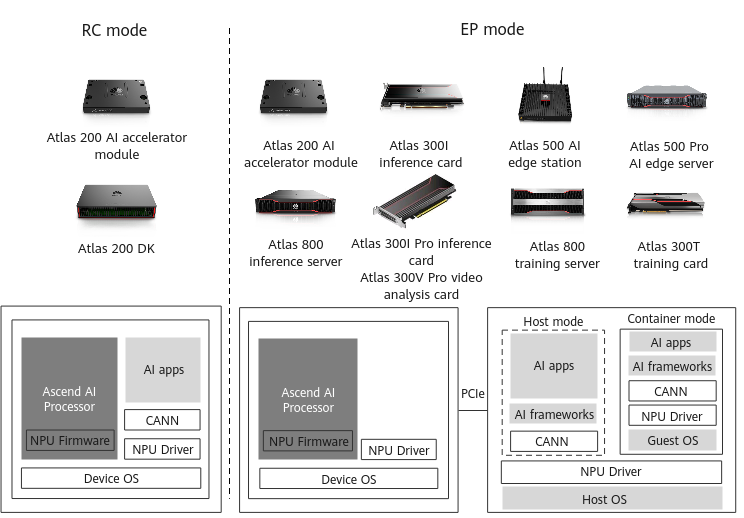
The following uses the Ascend AI Processor as an example. If the PCIe works as the master and supports peripherals, this mode is referred to as the RC mode (or Ascend RC in the following). If the PCIe serves as a slave, this mode is referred to as the EP mode (or Ascend EP in the following).
- The working modes of the Ascend AI Processor are as follows:
- Ascend 310 AI Processors support both the EP and RC modes.
- Ascend 310P AI Processors support only the EP mode.
- Ascend 910 AI Processors support only the EP mode.
- The following products support the RC mode: Atlas 200 AI accelerator module and Atlas 200 DK
The CPUs of such products run the AI service software specified by the running user directly and connect to peripherals such as network cameras, I2C sensors, and SPI monitors as slave devices.
- The following products support the EP mode:
Ascend 310 AI Processor: Atlas 200 AI accelerator module, Atlas 300I inference card, Atlas 500 AI edge station, Atlas 500 Pro AI edge server, and Atlas 800 inference server
Ascend 310P AI Processor: Atlas 300I Pro inference card and Atlas 300V Pro video analysis card
Ascend 910 AI Processor: Atlas 800 training server and Atlas 300T training card
In EP mode, the host acts as the master, the device acts as the slave, and customer's AI apps run on the host. The product, as a device, connects to the host over the PCIe interface, while the host loads AI tasks to the Ascend AI Processor on the device over the PCIe interface.
Figure 1 shows the products and architecture of the two modes.
The concepts of host and device are described as follows:
- Host: an x86 server or an Arm server connected to the hardware powered by an Ascend AI Processor. It leverages the neural network (NN) compute capability provided by the Ascend AI Processor.
- Device: a hardware backend powered by an Ascend AI Processor. It provides the server with the NN compute capability over the PCIe interface.