Applicability
Product |
Supported |
|---|---|
√ |
|
√ |
|
☓ |
|
☓ |
|
√ |
Description
Performs the sum operation (or other reduction operations) on the data of all ranks and sends the result to the specified position on the root rank.
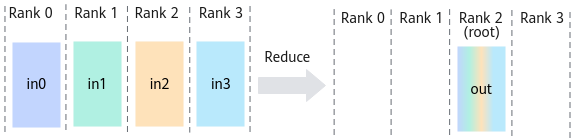
Prototype
1 | HcclResult HcclReduce(void *sendBuf, void *recvBuf, uint64_t count, HcclDataType dataType, HcclReduceOp op, uint32_t root, HcclComm comm, aclrtStream stream) |
Parameters
Parameter |
Input/Output |
Description |
|---|---|---|
sendBuf |
Input |
Address of the send buffer. |
recvBuf |
Output |
Address of the buffer to receive collective communication result. |
count |
Input |
Number of data records to perform Reduce operation. For example, if only one int32 data record is involved, then count=1. |
dataType |
Input |
Data type of the reduction operation, which is of the HcclDataType type. |
op |
Input |
Reduction operation type. Currently, the following operation types are supported: sum, prod, max, and min. NOTE:
|
root |
Input |
ID of the root rank used for the reduction operation. |
comm |
Input |
Communicator where the operation is performed. |
stream |
Input |
Stream of the rank. |
Returns
HcclResult: HCCL_SUCCESS on success; else, failure.
Constraints
- All ranks must have the same count, dataType, and op.
- The input and output addresses (sendBuf and recvBuf) of the operator must meet the following alignment requirements based on different data types:
- int8: 1-byte aligned
- int16, float16, bfp16: 2-byte aligned
- int32 and float32: 4-byte aligned
- int64: 8-byte aligned
Example
1 2 3 4 5 6 7 8 9 10 11 12 13 14 15 16 17 18 19 20 21 22 23 24 25 26 27 | // Allocate device memory for collective communication. void *sendBuf = nullptr; void *recvBuf = nullptr; uint64_t count = 8; size_t mallocSize = count * sizeof(float); aclrtMalloc((void **)&sendBuf, mallocSize, ACL_MEM_MALLOC_HUGE_ONLY); aclrtMalloc((void **)&recvBuf, mallocSize, ACL_MEM_MALLOC_HUGE_ONLY); // Initialize the communicator. uint32_t rankSize = 8; HcclComm hcclComm; HcclCommInitRootInfo(rankSize, &rootInfo, deviceId, &hcclComm); // Create a task flow. aclrtStream stream; aclrtCreateStream(&stream); // Execute Reduce to add sendBuf of all ranks at the corresponding location and then send the result to recvBuf of the root rank. HcclReduce(sendBuf, recvBuf, count, HCCL_DATA_TYPE_FP32, HCCL_REDUCE_SUM, rootRank, hcclComm, stream); // Wait until the collective communication task in the task flow is complete. aclrtSynchronizeStream(stream); // Free resources. aclrtFree(sendBuf); // Free the device memory. aclrtFree(recvBuf); // Free the device memory. aclrtDestroyStream(stream); // Destroy the task flow. HcclCommDestroy(hcclComm); // Destroy the communicator. |